

Waterproofing company in Dubai, matched to the job
Roof, bathroom, terrace or basement. Describe where the water gets in and a partner waterproofing contractor inspects, quotes and signs with you.
A waterproofing company in Dubai seals the parts of a home that water attacks: the roof, bathrooms and kitchens, balconies and terraces, and anything below ground. Dubai Renovations takes your enquiry and briefs a partner waterproofing contractor, who inspects, quotes in writing, signs the contract with you and does the work. Three things decide the system: where the water comes from, what will sit on top of the membrane, and the temperature and humidity on the day it goes down.
A membrane is only as good as its details: the corners, drains, pipes through the slab and joints where a floor meets a wall. Sika's data sheets tell the applicator to finish those details before coating the open surface. This page covers each part of a Dubai home, what the Dubai Building Code requires, the limits printed on the makers' own data sheets, how a flood test works, and what a written waterproofing quote should list.
What does a waterproofing company in Dubai do?
The work splits by where the water comes from. Rain and sun attack a roof from above; showers and floor washing attack a bathroom from inside; groundwater pushes on a basement from outside. Each needs a different system, and the table sets out the rule or published limit that applies to each.
Sika's data sheets are cited on this page because they are public and written for the Gulf, not as a recommendation. A partner may specify another maker. Whatever the quote names, ask for that product's data sheet, because every figure a waterproofing job should meet is printed on it.
| Where | What attacks it | Typical system | The rule or published limit |
|---|---|---|---|
| Flat roof | Sun, heat and the occasional heavy rain | An exposed liquid membrane, or a membrane under insulation and paving | Part K of the Dubai Building Code requires waterproofing and thermal insulation on the rooftop |
| Bathroom, shower or kitchen | Water on the floor and around drains | A liquid membrane under the tiles, with the wall joints reinforced | Sika's Sikalastic WR: at least 2 coats, 0.5 mm dry film, always covered by tiles or stone |
| Balcony or terrace | Rain and washing water, with sun on top | A cement-based slurry under a protection screed and tiles | Sika's SikaTop-107 Seal AE: at least 2 coats, 1.5 to 2 mm in total, with a protection layer over it |
| Basement | Saline groundwater pressing on the walls and slab | A proprietary system designed with the structure | The Dubai Building Code points to BS 8102 for structure in contact with water |
| Ground-floor walls | Damp rising from the ground | A damp-proof course joined to the floor membrane | The Dubai Building Code asks for the course at least 150 mm above the adjoining ground |
Roof waterproofing in Dubai
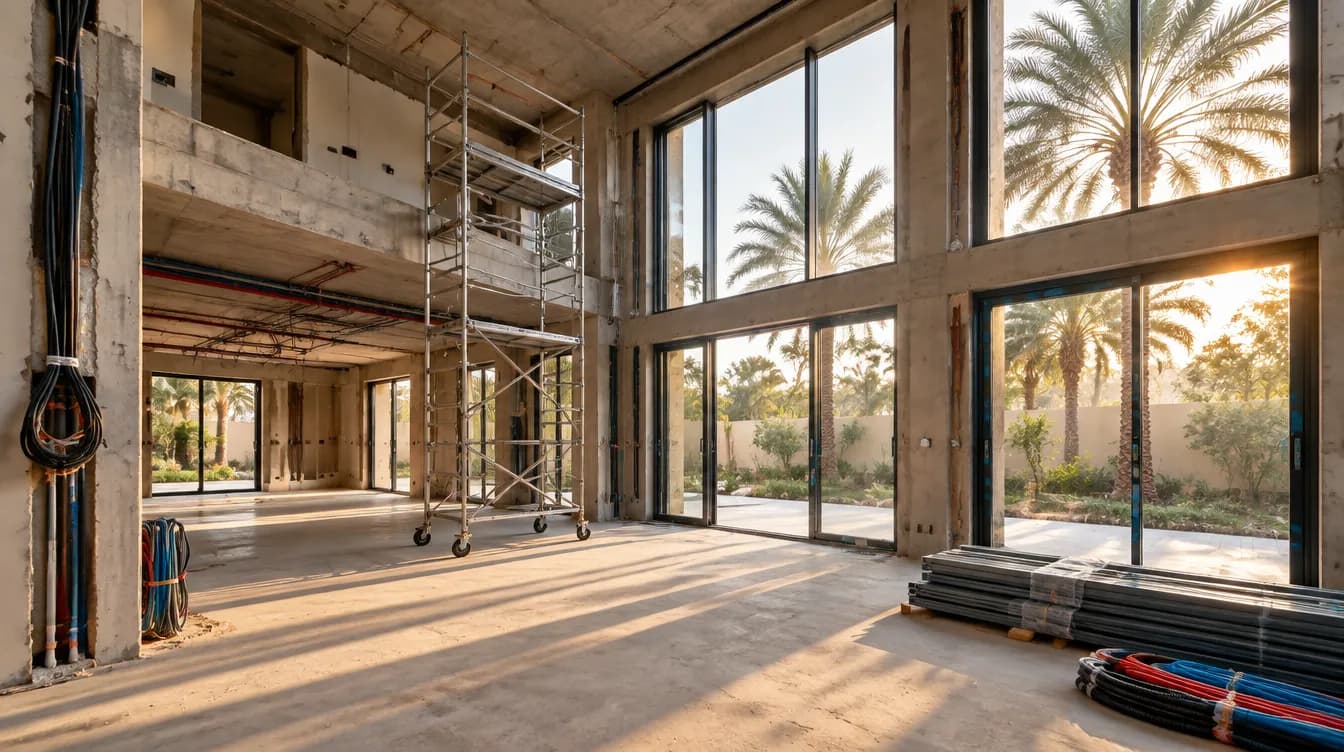
Part K of the Dubai Building Code makes roof waterproofing a requirement for villas: it says waterproofing and thermal insulation shall be fitted on the rooftop to protect it from water leaks and solar gain. The same part caps the roof's average thermal transmittance at 0.3 W/m²K, and requires a flat or low-sloped roof, at a slope of 1:6 or less, to have a solar reflectance index (SRI) of at least 78 over at least 75% of its area.
That last rule shapes the choice of top coat. Sika's exposed roof membrane Sikalastic-560 GCC lists an SRI of 90 in white, which clears 78; a darker colour needs its own figure. The same sheet asks for at least 3 coats, no more than 0.35 kg/m² per coat without reinforcement, and a reinforcing fleece or tape over cracks, joints and seams. It is not made for foot traffic: where people walk on the roof, it has to be covered with paving.
A roof coating also has a weather window. Sika allows air temperatures of +8 to +40 °C and relative humidity up to 80%, a surface at least 3 °C above the dew point, and a substrate below 6% moisture, with new concrete cured for at least 28 days. It says to apply during falling temperatures, because a coat laid on a warming roof pinholes as the air beneath expands. In a Dubai summer that points to the late afternoon, outside the midday break that stops work in direct sun from 12:30 pm to 3 pm between 15 June and 15 September, and not on an early morning when the dew is still on the slab.
Bathroom and kitchen waterproofing
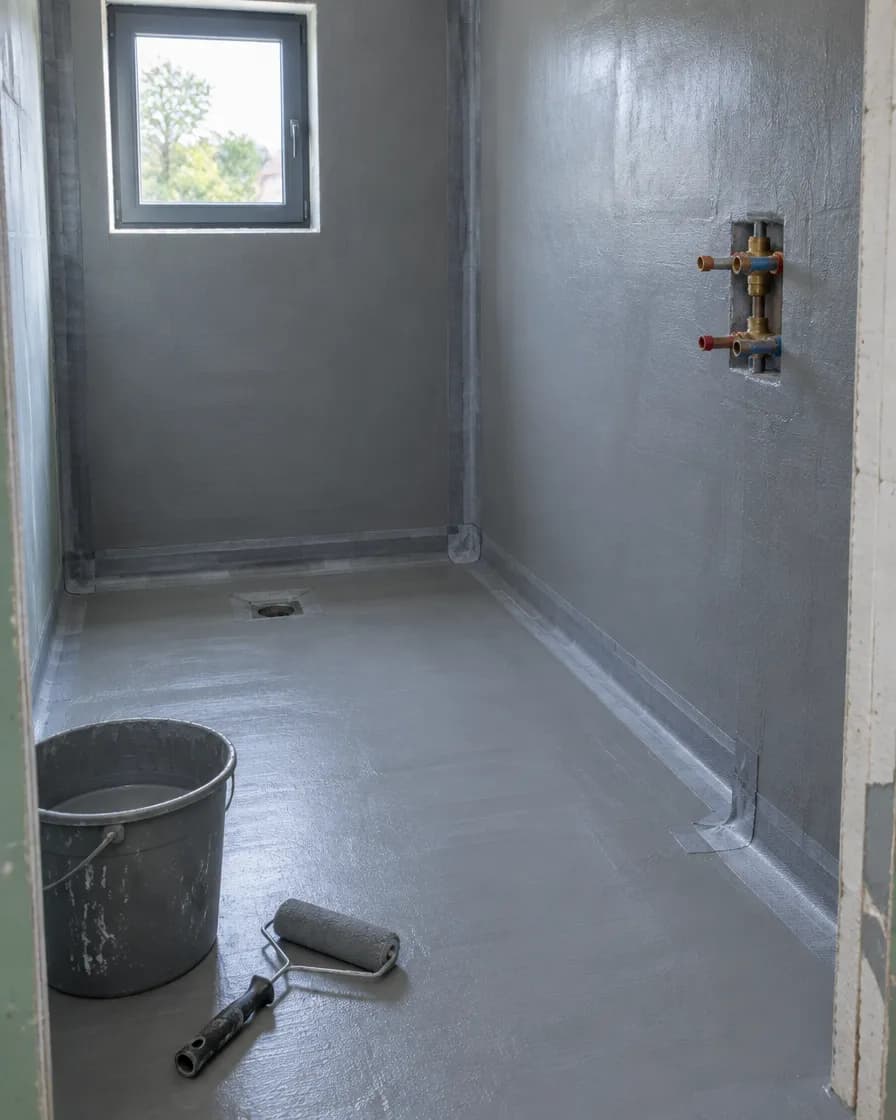
Under tiles, the membrane is a liquid coat bonded to the screed. Sika's Sikalastic WR is written for bathrooms, shower rooms, kitchens and plumbing rooms, and its sheet sets out what a proper job looks like: at least 2 coats, a dry film of at least 0.5 mm and at least 1.4 kg/m² in total. Every floor-to-wall joint gets a mortar fillet or a reinforcing tape, and drains and pipe outlets are sealed before the membrane goes on.
The membrane then has to be covered. The WR sheet calls for hard protection such as ceramic tiles or stone slabs, fixed with an EN 12004 class C2 adhesive once the second coat has fully cured, which Sika puts at about 2 days at 30 °C, 4 days at 20 °C and 6 days at 10 °C. A tiler who starts the day after the membrane is laid is working ahead of the maker's timetable.
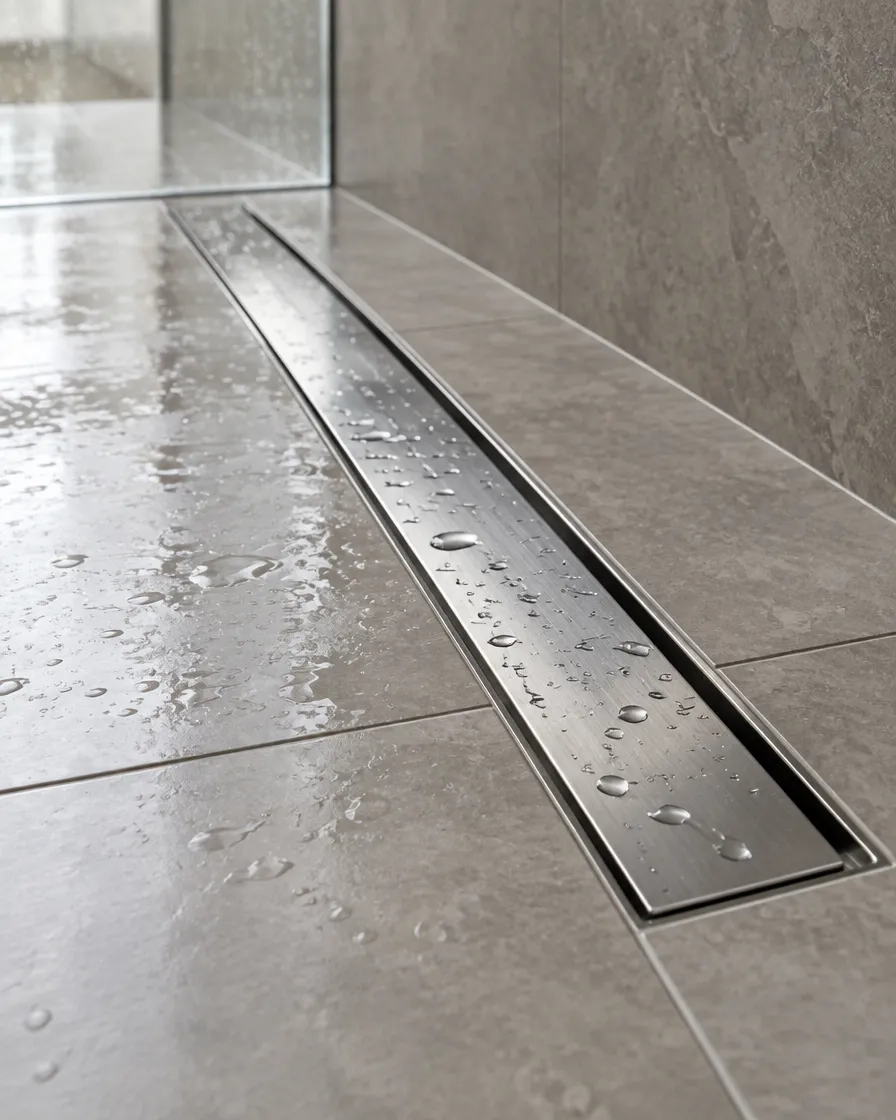
The Dubai Building Code sets the rules for the finish above the membrane: a waterproof seal between the floor finish and each drain grating, a non-absorbent base turned at least 100 mm up the walls, and shower walls finished to at least 1,800 mm above the drain outlet. The bathroom renovation page covers the rest of the room.
Rigid or flexible: choosing the membrane
Waterproofing products split into rigid cement-based slurries and flexible liquid membranes, and the question is whether the surface underneath will move. A slurry bonds hard to concrete and suits tanks, basement walls, terraces and wet areas under a screed. Sika says its SikaTop-107 Seal AE seals fine hairline cracks only where the concrete is not subject to movement. A flexible membrane bridges cracks that open and close with heat, which is why roofs take one.
| Type | Example data sheet | Where it suits | Limits on the sheet |
|---|---|---|---|
| Cement-based slurry, rigid | SikaTop-107 Seal AE | Tanks, basement walls, terraces and wet areas under screed and tiles | At least 2 coats, 1.5 to 2 mm; +8 to +35 °C; not a trafficable finish; avoid direct sun and strong wind while applying |
| Liquid membrane under tiles, flexible | Sikalastic WR | Bathrooms, showers, kitchens and plumbing rooms | At least 2 coats and 0.5 mm dry film; +8 to +40 °C; must be covered; not for permanent immersion |
| Exposed liquid roof membrane, flexible | Sikalastic-560 GCC | Exposed roofs, including over a sound old bituminous membrane | At least 3 coats; no foot traffic unless paved; not for buried or inverted roofs; no long-term ponding |
How does a flood test work?
A flood test holds water on the finished membrane to prove it before anything covers it. Sika's sheets for both its liquid membranes say the same thing: flood test only once the membrane is fully cured, with water 50 mm deep, for a maximum of 24 hours. Plug the drains, fill to a marked line, and check the ceiling below and the walls beside it before draining down.
Two shortcuts defeat the test. One is testing too early, on a membrane that has not cured, which the data sheets rule out. The other is skipping the test because the tiler is waiting. Ask for the flood test as a line on the quote, with the date it happens and who checks the room below.
Basements and Dubai groundwater
Below ground, the engineer designs the waterproofing with the structure. The Dubai Building Code describes Dubai's ground as calcareous sands and soft calcareous rocks, and its groundwater as saline with sulphates, a very aggressive environment for concrete and reinforcement in the ground. It limits crack widths in concrete that touches groundwater to between 0.2 mm and 0.05 mm, depending on the water pressure against the wall's thickness, against 0.3 mm for concrete kept dry. Those limits apply provided a proprietary waterproofing system to BS 8102 protects the structure in contact with water.
The code also recommends classifying a basement by the degree of protection against leakage it needs, a store room and a home cinema being different answers. A villa basement's soffit can sit no more than 1.5 m above the gate level, and the basement cannot extend beyond the plot. Adding one to an existing villa is an extension, covered on the villa extension page, and the waterproofing is designed by the engineer with the rest of it.
Above ground, the walls have a simpler rule: a damp-proof course at least 150 mm above the adjoining ground, joined to any damp-proof membrane in the floor. Damp that shows along the bottom of a ground-floor wall is the place to start looking.
Balconies, terraces and roof gardens
The Dubai Building Code asks horizontal surfaces in the building envelope to be jointless and impermeable, or to have sealed joints. A cement-based slurry under a protection screed is the usual answer. Sika's SikaTop-107 Seal AE sheet asks for a C2 tile adhesive over it, for the surface to be dampened before application in hot weather with no standing water, and for the work to avoid direct sun and strong wind.
A terrace people walk on needs something over the membrane. Sika's exposed roof membrane is not made for foot traffic and has to be paved over where it cannot be avoided. A roof garden adds planters, soil and irrigation above the waterproofing, and every pipe through it is a detail to seal. The landscaping page covers the planting side.
A leak in an apartment or a rented home
If you rent, the first call is to the landlord. Article 16 of Dubai Law No. 26 of 2007 makes the landlord responsible, unless the lease says otherwise, for maintenance and for repairing any defect that affects the tenant's use of the property. Article 19 says a tenant may not carry out maintenance works without the landlord's permission.
In a tower, your bathroom floor is someone else's ceiling, so building management sets the working hours and issues the NOC before a wet room is opened. The code adds one rare case: a wet room above a DEWA substation or electrical room is allowed only at DEWA's discretion, with a waterproofed attic slab and every pipe and trap in the wet area enclosed in an approved membrane. The apartment renovation page covers the NOC.
How much does waterproofing cost in Dubai?
Dubai Renovations does not publish a waterproofing price, for a roof or anything else. This site shows a price only when a named publisher gives it for the same job, and no source we could check did. What we can set out is what makes two quotes comparable.
Area is only part of it. The details take the time: metres of upstand, the number of drains and pipes through the slab, and how much old tile, screed or membrane has to come off first. The system sets the material, and the data sheets give quantities to check against: Sikalastic-560 GCC at 1.0 to 2.1 kg/m² depending on the build-up, Sikalastic WR at a minimum of 1.4 kg/m², and SikaTop-107 Seal AE at about 2 kg/m² per millimetre, so 3 to 4 kg/m² at its 1.5 to 2 mm thickness.
- The product named, the number of coats, and the kg/m² or dry film thickness
- Surface preparation and concrete repair, as measured items
- Reinforcement over cracks, joints, corners and drains
- For a roof: whether the old membrane stays, the insulation, and the top coat's SRI
- The flood test, and reinstating tiles, screed or paving afterwards
- Whether 5% UAE VAT, charged since 1 January 2018, is included
Which waterproofing company is best in Dubai?
Dubai Renovations does not rank waterproofing companies, and a list of names would not tell you whether your roof will leak. The first page of results for this search is contractor homepages that lead with years in business, project counts and warranty lengths, and directory and magazine lists of company names. None of them publishes a cure time or explains a flood test.
The contractor worth hiring is the one whose quote shows the method. It names the product and hands over its data sheet, states the coats and the thickness, lists the details, and puts the flood test on a date. Any warranty comes from the partner contractor who signs, so ask for its terms in writing before you sign.
- Where the water is coming from, and how that was checked
- The product, its data sheet, and the coats and thickness it calls for
- The moisture reading of the substrate against the sheet's limit
- Fillets or tape at every corner, and how drains and pipes are sealed
- The time of day the work happens in summer, against the sheet's temperature range
- The flood test, and what covers the membrane afterwards
What to send with your waterproofing enquiry
A partner contractor can plan the inspection from these details:
- Villa, townhouse or apartment, the floor, and the community or building
- Where the water shows, with photos of any stain, bubbling paint or loose tiles
- When it appears: after rain, after a shower is used, or all the time
- The roof, bathroom, terrace or basement you want waterproofed
- Whether you own the property or rent it
Questions
How much does waterproofing cost in Dubai?
Dubai Renovations does not publish a waterproofing price, because no source we could check gave one for the same job with a named publisher. The total rests on the area, the details, the removal of old finishes, the product and its thickness, the flood test and VAT. A partner contractor quotes in writing after inspecting.
How long before a waterproofed bathroom can be tiled?
Once the membrane has fully cured. Sika puts full cure of its Sikalastic WR at about 2 days at 30 °C and 4 days at 20 °C, and tiling follows the flood test, which uses 50 mm of water for a maximum of 24 hours.
Can a roof be waterproofed in the Dubai summer?
Yes, around the heat. Sika's roof membrane allows air temperatures up to +40 °C and asks for application while temperatures are falling, and the midday break stops work in direct sun from 12:30 pm to 3 pm between 15 June and 15 September.
Can I walk on a waterproofed roof?
Not on an exposed liquid membrane. Sika's sheet for Sikalastic-560 GCC says it is not recommended for foot traffic and must be covered with paving where walking cannot be avoided.
Who pays for a leak in a rented flat?
Unless the lease says otherwise, Article 16 of Dubai Law No. 26 of 2007 makes the landlord responsible for maintenance and for repairing defects that affect the tenant's use. Tell the landlord first.
Who signs the waterproofing contract?
You sign with the partner contractor, who does the work and gives any warranty. Dubai Renovations is not a party to the contract or the payments. For a full wet-room rebuild, see bathroom renovation.
Send the job on WhatsApp
Choose what fits and WhatsApp opens with the message written. Add a photo of each room in the chat.