
Guide, updated 1 November 2026
Microcement in Dubai
Microcement in Dubai works on floors, walls and showers when the base beneath it is sound and a shower is waterproofed underneath. It is a polymer-cement coating 1 to 3 mm thick. Topciment's sealer data sheet says the finish keeps out running water but not standing water, and Topciment and Ideal Work cap application at 30 °C.
Dubai Renovations does not apply microcement or sign the contract. A partner contractor inspects the room, quotes and signs with you.
How much does microcement cost in Dubai?
Dusk & Dune, a Dubai microcement applicator, publishes AED 210 to 400 per m² for floors and AED 190 to 295 per m² for walls, supply and installation, excluding VAT, with a minimum project value of AED 14,000 plus VAT. Plahton, a UAE materials marketplace, puts a standard-size microcement bathroom from about AED 9,000.
On this page
- What is microcement, and how is it different from cement?
- Where microcement works in a Dubai home, and where it struggles
- Can you use microcement in a shower?
- What goes under microcement in a wet room
- Why microcement cracks: the base and the movement joints
- Can microcement go straight over tiles?
- Dubai heat: when microcement can be applied
- Sealers and topcoats: what goes on last
- How long before you can use the room
- Cleaning microcement: what marks the finish
- Caring for it in the first weeks
- Is microcement more expensive than tiles?
- What a microcement quote should state
- Questions
What is microcement, and how is it different from cement?
Microcement is a cement mortar made to be laid thin. Topciment's data sheet for Evoluttion Microbase lists hydraulic binders, selected aggregates, synthetic resin and additives, with the largest grain 0.3 to 0.6 mm depending on the grade, forming a coating of 1 to 3 mm. Ideal Work calls its Microtopping a two-component polymeric cementitious system, 3 mm thick at most.
The resin and the fine grain are the difference. A cement screed is the bed a floor is built on. Microcement is a skin laid over a finished base, in layers no thicker than 1 mm each on Topciment's sheet. It cannot level a floor or make the fall to a drain, so that work is done before it starts.
The coating copies whatever is under it. Ideal Work asks for a floor base with a compressive strength of at least 25 MPa and a pull-off strength of at least 1.5 MPa, sanded or shot blasted, clean, intact and perfectly level. Topciment asks for a surface free of dust and grease, well consolidated and flat.
Where microcement works in a Dubai home, and where it struggles
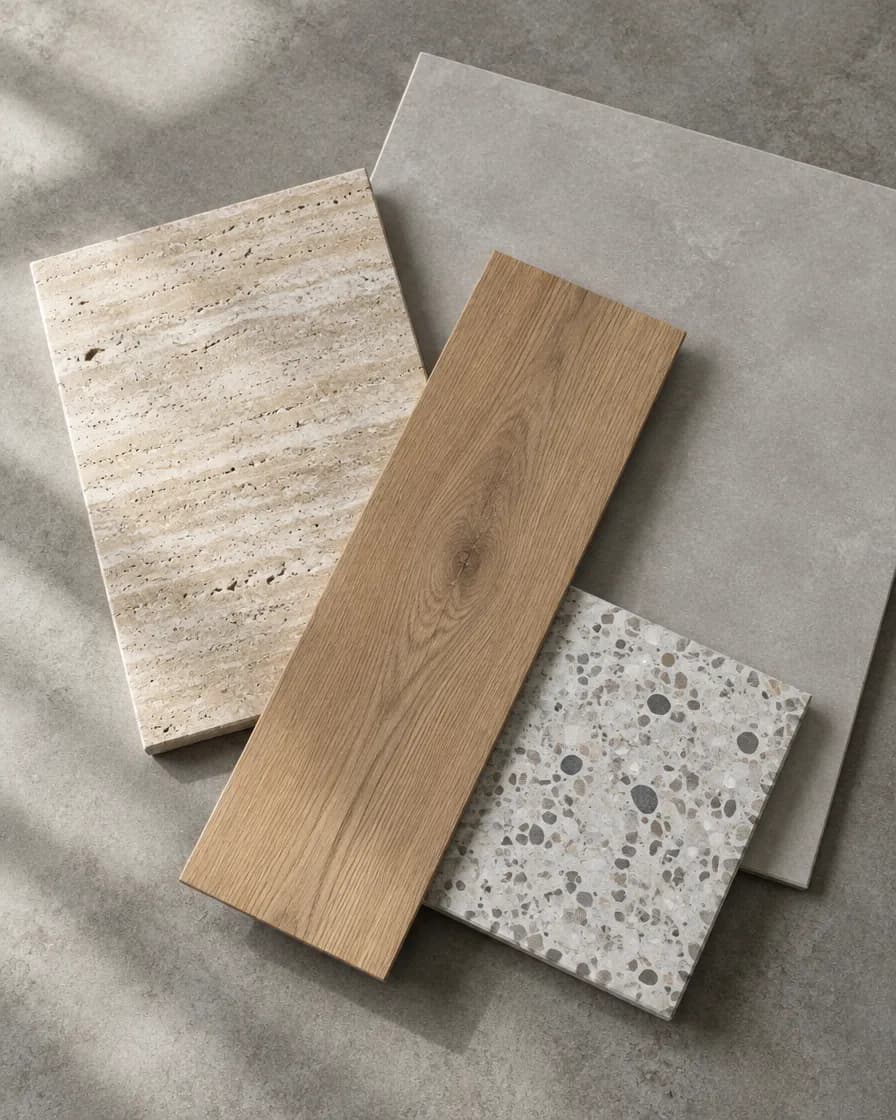
Both makers accept a long list of bases. Concrete, cement mortar, ceramic tile, plaster and plasterboard appear on both sheets, MDF on Topciment's and wood on Ideal Work's, each with conditions of its own.
| Surface | What the data sheet says | What to check first |
|---|---|---|
| Living and bedroom floors | Topciment: two preparation layers and its Builtex fibreglass mesh on every floor | A sound, flat screed, and where the villa's movement joints run |
| Walls | Topciment uses its Microfino finish coat only on walls and surfaces nobody walks on | Cracks in the plaster, which Ideal Work bridges with fibreglass mesh |
| Showers and wet rooms | Ideal Work lists shower cubicles and wet rooms; Topciment's wet-area varnish keeps out running water, not standing water | A membrane under the coating, a non-slip floor and the drain seal |
| Over existing tiles | Both list ceramic as a base; Ideal Work sands it with a diamond disc and meshes it first | Loose or hollow tiles, and the new floor and drain levels |
| Terraces and outside walls | Ideal Work lists both, with an acrylic sealer outdoors, and warns that sun makes areas set unevenly | Direct sun while it is laid, and the 30 °C ceiling |
| Pools | Topciment's pool system, Atlanttic Aquaciment, is not a waterproofing mortar and must never go over mosaic tiles or other microcement | A shotcrete or reinforced concrete shell, waterproofed before any coating |
On every surface, the base and what lies under it decide whether microcement lasts.
Can you use microcement in a shower?
Yes, with a waterproofing membrane under it. Topciment's data sheet for TopSealer WT Dragon, the varnish it recommends for wet areas, says the sealer waterproofs microcement against running water, meaning occasional contact, and is not a waterproofing agent against standing water, meaning permanent contact. So the sealer cannot be what keeps water out of the slab.
For a villa or townhouse, Part K of the Dubai Building Code sets the finish. Clause K.5.7.1 asks for a smooth, hard, non-absorbent floor in bathrooms and shower rooms, and shower walls finished non-absorbent to at least 1,800 mm above the drain outlet. The same clause asks for the floors of showers and other sanitary fixtures to be made of non-slip materials.
Smooth and non-slip pull against each other on a trowelled finish. Topciment makes a separate two-component anti-slip varnish, TopSealer WT Anti Slip, and Duraamen's shower diagram adds an anti-skid additive to its topcoat. Ask which one goes on your shower floor, and stand on a wet sample before you agree.
The drain is the joint to watch. Clause K.10.3.2.3 requires a waterproof seal between the floor finish and the edge of the drain grating, and a drain body chosen to suit the floor finish. Part K covers villas and townhouses; an apartment tower falls under the code's other Parts and the building's own fit-out rules, which the apartment renovation page covers.
What goes under microcement in a wet room
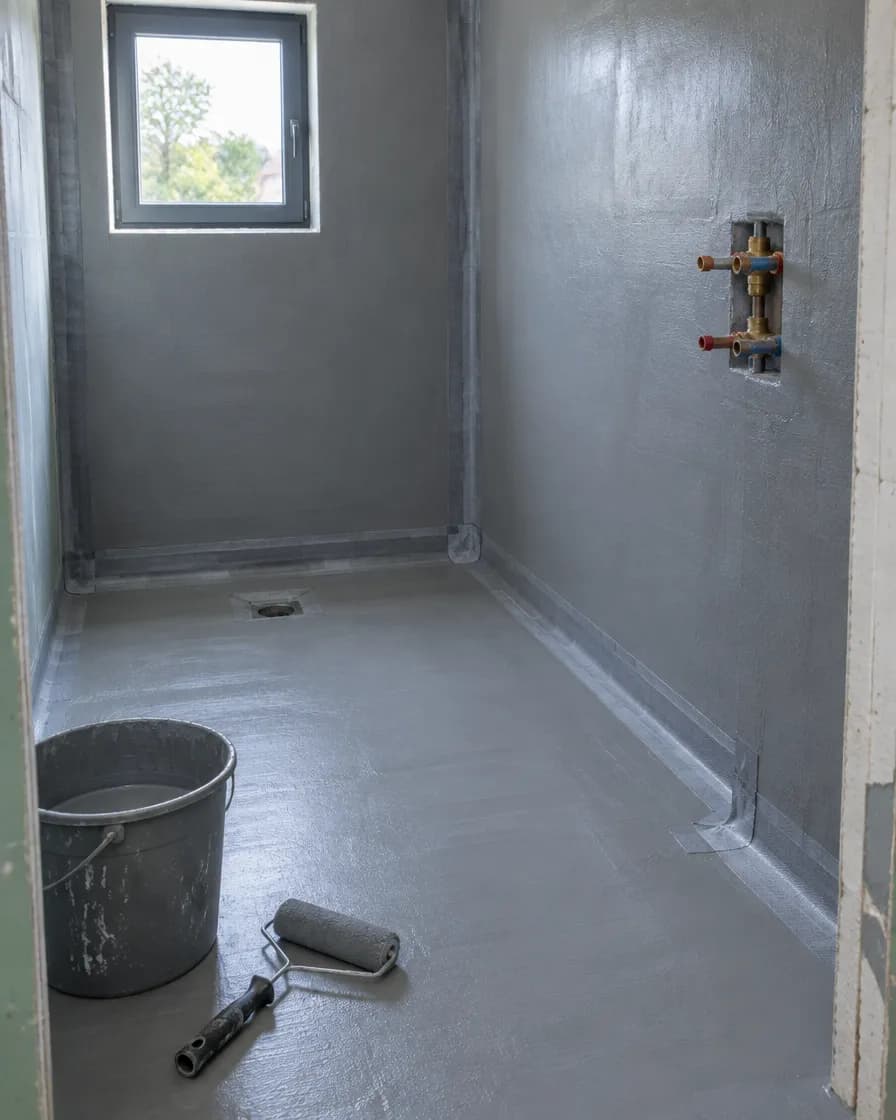
Duraamen, a US maker of microcement, publishes a shower build-up for its Skraffino system that shows the layers to ask about, in order. The diagram says each product's own data sheet governs its installation:
Read any other system against the same three questions: what holds the water, what the coating bonds to, and what seals it. Then test the membrane before anything covers it. The roof, bathroom and terrace waterproofing guide explains what a proper flood test looks like, and the waterproofing company in Dubai page covers the membranes themselves.
- A sloped bed of fibre-reinforced mortar over a recessed subfloor, falling to a flange-type drain, with moisture-resistant board on the walls
- Fibreglass mesh across the joint between wall and floor, at least 12 inches (about 300 mm) each way, under the waterproofing
- The waterproofing membrane, taken at least 12 inches past the high point of the floor
- A skim coat of the same fibre-reinforced mortar over the membrane, giving the microcement a mortar base rather than the membrane
- Two to three layers of microcement, two coats of polyurea-polyaspartic coating and a urethane topcoat, with an anti-skid additive as an option
Why microcement cracks: the base and the movement joints
Most cracks start below the coating. Ideal Work's data sheet says shrinkage cracks in the base inevitably carry through to the Microtopping finish. Where a concrete or sand-cement base shrinks by more than 300 μm per metre in 28 days, it advises waiting until the base has cured and dried completely, and sealing its cracks with epoxy first.
Topciment describes its coating as continuous and without fissures, then adds: always respect the expansion joints. Ideal Work says to respect any control joints in the base. Where two areas of Microtopping meet, it lays a 5 cm canvas tape, cuts along it once the coating is dry, and fills the cut with neutral silicone.
Villas have joints for a reason. Clause K.8.5.6 of the Dubai Building Code asks for movement joints where above-ground structures need them for expansion or deflection, and notes that movement joints are a common source of water infiltration. Under both makers' instructions a structural joint shows through the finish as a joint, so plan where it falls before choosing the colour.
Topciment also requires its Builtex fibreglass mesh under the preparation layers on every floor. Ideal Work fixes an 80 to 100 g/m² fibreglass mesh over old ceramic, and a sheet of mesh over cracks or gaps in a wall.
Can microcement go straight over tiles?
Over sound tiles, yes, after preparation. Ideal Work's sequence for a ceramic floor is to sand it with a diamond disc, fix an 80 to 100 g/m² fibreglass mesh with its IW-Blocker, then apply an epoxy coat broadcast with quartz sand: two coats where grout lines remain, one where there are few or none. On ceramic walls it sands, fills the grout joints and rolls on a primer.
Topciment lists ceramic as a base too, with adhesion promoters such as Primacem PLUS or Primacem ABS where a surface needs one. Both makers ask for a base that is intact and consolidated, so any loose, hollow or cracked tile comes out and is made good first.
Covering tiles saves the demolition, but the floor comes up. Doors, thresholds and the drain grating all have to meet the new surface. In a shower, the old waterproofing stays buried under the old tiles, so ask whether it will be tested or replaced before it is covered for good. The flooring company in Dubai page covers the same levels question for other floors.
Dubai heat: when microcement can be applied
Both makers set a ceiling of 30 °C. Topciment's Evoluttion sheets ask for an ambient temperature between 10 °C and 30 °C and mixing water at 10 °C to 20 °C, and its TopSealer WT Dragon narrows the range to 15 °C to 30 °C. Ideal Work rules out application above 30 °C, below 10 °C, or with relative humidity above 70%.
Outdoors, Dubai's climate leaves a short window. On the National Center of Meteorology's normals for 1974 to 1991, published by the World Meteorological Organization, the average daily high is 32.4 °C in April and 30.5 °C in November, and above 35 °C from May to October. Only December to March average below 30 °C, from 24.0 °C in January to 27.9 °C in March.
Indoors, air conditioning can hold a room inside the range, but only if it runs through mixing, every layer and the whole cure. Ask how the room will be kept between 10 °C and 30 °C while the coating goes on, and between 15 °C and 30 °C for the sealer.
Sun is a separate problem on a terrace. Ideal Work warns against conditions that make areas set at different speeds, naming air currents and solar radiation, and specifies an acrylic sealer, Ideal Sealer M, for outdoor work. Topciment says TopSealer WT Dragon does not yellow in sunlight. Ask when in the day each part of a half-shaded terrace will be laid.
Sources
Sealers and topcoats: what goes on last
The sealer is the surface you touch and clean, and it goes on only once the coating is dry. Topciment seals after 24 to 48 hours, when a moisture meter reads below 5%. Ideal Work applies its protective resin no earlier than 48 hours on floors and 24 hours on walls, at 20 °C to 30 °C and no more than 60% relative humidity.
The sealer can change the colour as well. Ideal Work's sheet says the resin can change the hue of the surface, in some cases significantly, so approve the colour on a sealed sample, never a bare one.
How long before you can use the room
Topciment's sheets set out the whole sequence for a floor, and the waits add up:
| Step | What goes on | Wait before the next step |
|---|---|---|
| Base | An adhesion promoter where needed, and Builtex fibreglass mesh on every floor | As that product's own sheet says |
| Preparation coats | Two layers of Evoluttion Microbase, each no thicker than 1 mm, sanded with 40-grit between them | Until the layer has dried |
| Finish coats | Two layers of Evoluttion Microdeck, bringing the whole system to the recommended 3 mm | About 3 hours between layers |
| Hardening | Nothing | 24 to 48 hours, and a moisture reading below 5% |
| Pore filler | Presealer | At least 12 hours |
| Varnish | Two coats of TopSealer WT Dragon, the first sanded with 400-grit | 18 to 36 hours between coats |
| Cure | Nothing | At least a week before water or detergent, and 15 days before a rug or doormat |
On Topciment's own figures, a sealed floor needs at least a week after its last varnish coat before it gets wet.
Cleaning microcement: what marks the finish
Clean it with a damp cloth and neutral soap. Topciment's TopSealer WT Dragon sheet names a non-abrasive damp cloth with its own Ecoclean detergent or neutral soap, and rules out bleach, acetone and hydrochloric acid. Ideal Work recommends neutral detergents for Microtopping.
Topciment tested two coats of the varnish, cured for seven days, against household products. Its table shows where marks begin:
- Water and soap: no visible change after a week of contact
- Cooking oil: no change after a day
- Bleach and wine: a slight change after 8 hours
- Vinegar: a slight change after 3 hours, a moderate visible mark after a day
- Ammonia cleaner and hydrogen peroxide: a slight change after 8 hours
- 70% alcohol and 10% caustic soda: a slight change within an hour, a moderate mark by 8 hours
- Hydrochloric acid cleaner (salfumán): a moderate mark by 3 hours
Wipe vinegar and wine off a microcement worktop or floor at once, and keep bleach and acid cleaners away from it altogether.
Caring for it in the first weeks
The varnish is still curing for the first one to two weeks. Topciment says not to wet the floor or use detergent until the varnish has cured for at least a week, and that polyurethanes reach their full chemical resistance after 7 to 14 days. Keep rugs and doormats off it for 15 days.
Its anti-slip varnish sheet adds one habit worth keeping: rinse soap or detergent residue off straight away, because it can leave marks or grooves in the finish.
Is microcement more expensive than tiles?
Usually, per square metre installed. Dusk & Dune, a Dubai microcement applicator, publishes AED 210 to 400 per m² for floors, AED 190 to 295 per m² for walls and AED 190 to 400 per m² for bathrooms and wet areas, supply and installation, excluding VAT. It also sets a minimum project value of AED 14,000 plus VAT, which outweighs the rate on one small bathroom.
Plahton, a UAE materials marketplace, wrote on 14 October 2026 that a standard-size microcement bathroom in Dubai starts from roughly AED 9,000, with wet-zone walls around AED 350 per m², other walls around AED 220 per m² and floors around AED 250 per m². Against that it puts tile installation labour at AED 50 to 90 per m².
Plahton's tiled bathroom, a typical 15 m² room, costs AED 2,000 to 4,000 to install with adhesive, grout and waterproofing, before the tiles themselves are bought. Price the tiles you would actually choose before comparing. The bathroom renovation cost guide covers the rest of a bathroom budget.
Repair is where the two differ most. A tiled floor can be mended one tile at a time if spares from the same batch are kept. Microcement is one continuous surface, and Ideal Work says its finished look depends on the laying method, the timing and the climate on site, so a patch laid months later can read differently. Ask how a crack would be repaired.
What a microcement quote should state
Each maker's data sheet sets the coats, thicknesses and waits, so the quote should name the system before anything else. Ask for the data sheet of every product listed, and check the quote against it line by line.
When you are ready for one, the bathroom renovation and interior renovation pages explain how we match you with a partner contractor. The partner inspects the room, prices the system and signs the contract with you. The quote should state:
- The maker and system, and every product by layer: primer or adhesion promoter, mesh, preparation coats, finish coats, pore filler and varnish
- The number of coats and the total thickness, against the maker's limit of 3 mm on Topciment's and Ideal Work's sheets
- How the base is checked and repaired, and where movement joints will run through the finish
- In a shower: the membrane, how high it runs, how the drain is sealed, when it is flood tested, and how the floor is made non-slip
- How the room is kept inside the maker's temperature range through application and cure
- The moisture reading before sealing, the sealer's coats, and the date you can first use the room
- Which cleaning products the sealer allows, in writing
- Any minimum project value, and whether the 5% VAT is included
Published prices and their sources
| Item | Published range | Source |
|---|---|---|
| Microcement flooring | AED 210 to 400 per m² | Dusk & Dune, supply and installation for a standard residential project, per square metre, excluding VAT; the page shows no date, and the applicator's separate floors page prints AED 220 to 400, accessed 2026-11-01 |
| Microcement walls | AED 190 to 295 per m² | Dusk & Dune, supply and installation for a standard residential project, per square metre, excluding VAT; the applicator's separate walls page prints AED 210 to 285, accessed 2026-11-01 |
| Microcement for bathrooms and wet areas | AED 190 to 400 per m² | Dusk & Dune, supply and installation for a standard residential project, per square metre, excluding VAT, accessed 2026-11-01 |
| Minimum project value | AED 14,000 | Dusk & Dune, the applicator's minimum order for any microcement job, plus VAT, accessed 2026-11-01 |
| Full microcement bathroom, standard size | From about AED 9,000 | Plahton, a standard-size Dubai bathroom in microcement, installed; article published 14 October 2026, accessed 2026-11-01 |
| Microcement, wet-zone walls | About AED 350 per m² | Plahton, vertical surfaces in the shower or wet zone, installed; article published 14 October 2026, accessed 2026-11-01 |
| Microcement, other walls | About AED 220 per m² | Plahton, bathroom walls outside the wet zone, installed; article published 14 October 2026, accessed 2026-11-01 |
| Microcement, floors | About AED 250 per m² | Plahton, bathroom floors, installed; article published 14 October 2026, accessed 2026-11-01 |
| Tile installation labour | AED 50 to 90 per m² | Plahton, standard tile installation, labour only, tiles excluded; article published 14 October 2026, accessed 2026-11-01 |
| Tiling a typical 15 m² bathroom | AED 2,000 to 4,000 | Plahton, installation only, including adhesive, grout and waterproofing, excluding the tile material; article published 14 October 2026, accessed 2026-11-01 |
Questions
Is microcement waterproof?
Not on its own. Topciment says its TopSealer WT Dragon varnish waterproofs microcement against running water but not standing water. In a shower, the waterproofing is a membrane under the coating, tested before the microcement goes on.
How thick is a microcement floor?
About 3 mm in total. Topciment's Evoluttion sheets recommend a combined thickness of 3 mm with no layer over 1 mm, and Ideal Work gives 3 mm as the maximum for Microtopping. The base under it must already be level.
Is microcement cheaper than tiling?
Usually not. Dusk & Dune publishes AED 210 to 400 per m² for microcement floors, supply and installation, excluding VAT. Plahton puts tile installation labour at AED 50 to 90 per m², before the tiles themselves are bought.
How long before I can use a microcement shower?
On Topciment's sheets, the coating waits 24 to 48 hours before sealing, the varnish needs 18 to 36 hours between its coats, and then at least a week to cure before it is wetted or cleaned with detergent. Ask the contractor for those dates in writing.
Can I apply microcement myself?
Ideal Work's data sheet says its products are intended for professional use only, and that only practice and experience let an applicator control each stage. A shower also needs a membrane and a flood test before any coating goes on.
Which microcement is best?
The one whose data sheet covers your surface. Check that the system is rated for floors if you will walk on it, lists wet areas for a bathroom, and names an outdoor sealer for a terrace. Then compare the quote with that sheet line by line.
Who signs the microcement contract?
The partner contractor, who applies the system and gives any warranty. Dubai Renovations is not a party to the contract, the payments or the warranty.