

Home renovation in Dubai
Several rooms, one plan. Tell us what you want to change at home and a partner contractor visits, quotes and signs with you.
Home renovation in Dubai means changing several rooms of a villa, townhouse or apartment under one plan: kitchen, bathrooms, flooring, ceilings, lighting and joinery. Dubai Renovations takes your enquiry and briefs a partner contractor, who visits, quotes, signs the contract with you and does the work. Three things set the scope: whether walls or plumbing move, what your building or community approves, and the condition the old finishes are hiding.
A home renovation rarely stops at one room. The kitchen comes out, so the flooring runs through, so the ceiling gets redone for new lighting. This page covers how to rank the rooms, the order the work runs in, who has to approve it, and the Dubai Building Code figures that shape a new layout.
What does a home renovation in Dubai usually include?
A home renovation in Dubai falls somewhere between a refresh of the finishes and a rebuild that moves walls and adds space. The Dubai Building Code sorts changes to an existing building into classes, and the class tells you how much design and approval work comes with the job. A finishes refresh sits at the light end, and an extension that adds built-up area sits at the heavy end.
Most whole-home jobs in Dubai mix classes. New bathrooms rebuilt in place, rewiring and a kitchen opened to the living room can all sit in one contract. Tell Dubai Renovations which rooms change and roughly how far, and the partner contractor sorts the scope into the right class at the visit.
| Scope | What changes | Dubai Building Code class | What the partner needs to see |
|---|---|---|---|
| Finishes refresh | Paint, flooring, gypsum ceilings, light fittings and joinery | Renovation: a change to linings or finishes with no reconfiguration of internal spaces | Photos of each room and a list of the finishes you want |
| Services upgrade | Rewiring, new pipes, AC ductwork, a kitchen or bathroom rebuilt in place | Modification: a fit-out or a change to a service system or building element | The distribution board, the water heaters, the AC units and any leak history |
| Layout change | Walls removed or added, a kitchen or bathroom moved | Modification, with structural drawings where a wall carries load | Floor plans and the building or community renovation rules |
| Extension | Extra rooms, an enclosed terrace or a new floor | Addition: an increase in gross area, built-up area, height or depth | The plot plan and any approvals issued for the home before |
Rank the rooms before anyone quotes
Write down every change you want for the home, then sort it into three lists: must happen, would like, and only if the budget allows. A partner contractor can price all three lists at one visit, so you see what the extras cost before you commit to them, and you can drop a list without redesigning the rest.
Rooms that share services belong in the same phase of a home renovation. A kitchen and the bathroom behind the same wall often share plumbing routes, and new flooring laid before a kitchen is fitted can be damaged during the installation. Grouping those rooms means the walls and floors are opened once.

In what order does the work happen?
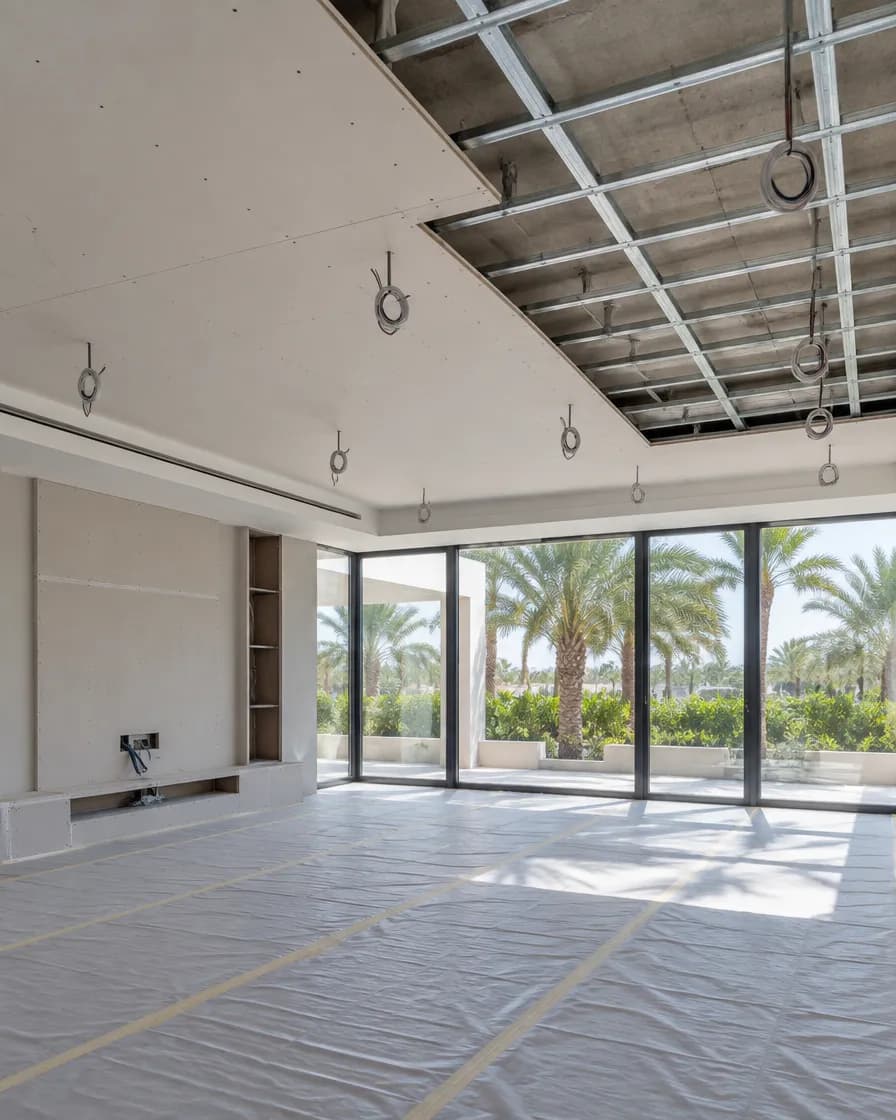
Most whole-home renovations in Dubai follow the same sequence, and the partner contractor's written programme should show it. If a quote has flooring going down before the plumbing is moved, or painting before the ceiling cables are in, ask the partner to explain the order before you sign.
- Protection of the rooms you keep, then demolition and debris removal
- First fix: new pipes, cables and AC ductwork inside walls and ceilings
- Plastering, screeding and gypsum ceilings
- Waterproofing in wet areas, then tiling and flooring
- Joinery, kitchen cabinets and wardrobes
- Painting, then second fix: switches, lights, taps and sanitaryware
- Testing, snagging and cleaning before handover
Who has to approve a home renovation in Dubai?
In a managed villa community, the community management approves alterations. Emaar Community Management tells owners in Emirates Living and Arabian Ranches that any alteration to the villa has to be approved by Emaar, applied for by selecting Home Modifications in the community portal. In Arabian Ranches, interior painting and regular maintenance need no NOC, although the contractor still needs an entry permit. Palm Jumeirah, Jumeirah Village Circle and Dubai Hills Estate have their own routes too, and the villa renovation page lists them.
An apartment is jointly owned property. Article 39 of Dubai Law No. 6 of 2019 says an occupant may make substantial alterations to the structure or external appearance of a unit only after approval from the master developer, the Dubai Land Department and the competent authority. Building management also issues its own no objection certificate (NOC) and sets the working rules. The apartment renovation page covers what Dubai Marina, Downtown Dubai, Business Bay and JLT ask for.
Structural changes can need an authority permit as well. In Dubai Development Authority areas, the contractor applies for a building modification permit with an appointment letter signed by the owner, the consultant and the contractor. If you rent, Article 19 of Law No. 26 of 2007 says a tenant may not make changes without the landlord's permission. Dubai Renovations does not apply for any of these; the partner contractor who quotes the job does.
Sources
- Home modifications, Emirates Living (Emaar Community Management)
- Home modifications, Arabian Ranches (Emaar Community Management)
- Law No. (6) of 2019 on jointly owned real property (Dubai Legislation Portal)
- Building modification permit (Dubai Development Authority)
- Law No. (26) of 2007 on landlords and tenants (Dubai Legislation Portal)
What does the Dubai Building Code require when a layout changes?
When a home renovation moves walls, the new rooms have to meet the Dubai Building Code's minimum sizes. For villas and townhouses, a bedroom or living room needs at least 10.5 m² of net area and at least 3 m in both length and width. An enclosed kitchen needs at least 5.4 m² and 1.8 m across, with 1.2 m of clear space between facing counters.
Height and openings matter too. The code sets a minimum clear height of 2.7 m in living rooms and bedrooms and 2.3 m in other spaces, measured from the finished floor to the ceiling or any beam below it. Bathroom doors need a clear width of at least 710 mm and entry doors 915 mm. Bedrooms, living rooms and kitchens need windows with a net glazing area of at least 10% of the floor area.
Those figures are why a partner contractor asks for floor plans early. Splitting one large bedroom into two, or dropping a gypsum ceiling in a room that is already low, can fail the code even when it looks fine on a sketch.
Summer work and the midday break
A home renovation that runs through a Dubai summer has to work around the UAE midday break. Work under direct sunlight and in open places is not allowed between 12:30 pm and 3 pm from 15 June to 15 September every year. Garden work and roof work done in the sun fall under that rule, so a partner's programme for those months moves outdoor tasks to the morning and late afternoon.
Payments, VAT and changes
Agree payment stages tied to finished work, such as demolition complete or tiling complete, rather than dates. Ask how a change is priced once work has started, and get that process in writing before the first payment. Keep part of the final payment until the snagging list is closed.
Check how the quote treats VAT. The UAE introduced Value Added Tax on 1 January 2018 at a standard rate of 5%, so a quote that leaves VAT out of the total will read 5% lower than the invoice. Any warranty on the work comes from the partner contractor, so ask for its terms in the contract.
What to send with your enquiry
The brief Dubai Renovations sends a partner is only as good as what you tell us. The most useful details are:
- Villa, townhouse or apartment, and the community or building
- Which rooms change and what you want in each
- Photos of each room, and floor plans if you have them
- A budget band and the month you hope to start
- Whether you own the property or rent it
Questions
Is home renovation different from villa renovation?
Home renovation covers any property: villa, townhouse or apartment. The villa renovation page goes further into community approvals, extensions, pools and outdoor work that only apply to villas.
Do I need to move out during a home renovation?
It depends on the scope. A room-by-room job can run while you live there if the partner agrees a phased plan. Work that removes the kitchen, cuts the water or fills the house with dust is easier to live away from.
Can I renovate in stages?
Yes. Ask the partner to plan the whole home at the first visit, even if you only build the first stage, so services laid now suit the rooms you renovate later.
Does a renovation quote in Dubai include VAT?
Check the quote. VAT in the UAE has been charged at a standard rate of 5% since 1 January 2018, according to the UAE Ministry of Finance. Ask the partner contractor to show whether the total includes it.
Who do I pay?
You pay the partner contractor under the contract you sign with them. Dubai Renovations is not a party to that contract.