

Guide, updated 17 November 2026
Roof, bathroom and terrace waterproofing in Dubai
Roof, bathroom and terrace waterproofing in Dubai starts with finding where the water comes from: a roof or terrace after rain, a wet room after use, damp rising from the ground, or a pipe under pressure. Each needs a different system and a different test, and Part K of the Dubai Building Code sets a villa rule for each.
Dubai Renovations does not apply waterproofing or sign the contract. A partner waterproofing contractor inspects, quotes and signs with you.
On this page
- Why is my villa leaking?
- What Part K of the Dubai Building Code asks of a villa
- Roofs: falls, overflows and what passes through them
- Bathrooms: the membrane, the drain and the dry trap
- Terraces and balconies over rooms
- How to tell a proper flood test from a quick one
- Roofs and pools: when a flood test is the wrong test
- What to ask before you sign
- Questions
Why is my villa leaking?
Start with the timing, because it narrows the search before anyone opens a floor. A stain that grows after rain points at the roof, a terrace or a parapet. One that appears after a shower is used points at that wet room's membrane, its drain or the joints around them.
Damp along the bottom of a ground-floor wall points at the damp-proof course. A patch that stays wet when nothing has been used for hours may be a pipe under pressure.
DEWA, which supplies Dubai's water, puts its High Water Usage Alert service first for catching a hidden leak: it warns of usage high enough to suggest a leak inside the property. DEWA names the bill and the water meter as the other ways to find one. It names bathrooms, kitchens, water tanks and swimming pools as the places to check.
That matters for the quote. A leaking supply pipe is a plumbing repair, and a new membrane laid over it fixes nothing. Ask any contractor who inspects to say what was tested and what was ruled out before a membrane is priced. The membranes themselves, with their makers' coats, thicknesses and cure times, are on the waterproofing company in Dubai page.
What Part K of the Dubai Building Code asks of a villa
Part K is the code's standalone part for detached villas and townhouses. It names no membrane product. It sets what the building has to achieve where water attacks it, and those clauses are the brief a waterproofing contractor works to.
| Where | Clause | What it requires |
|---|---|---|
| Roof | K.5.2.8.3 | Waterproofing and thermal insulation fitted on the rooftop against water leaks and solar gain |
| Exposed roofs and canopies | K.10.3.4.3 | A fall of no more than 1/50 and no less than 1/70 towards channels, gutters or outlets, and an emergency overflow on every parapet roof |
| Small areas open to the sky | K.10.3.4.3 | Internal roof or paved areas open to the sky with a catchment of 16 m² or less get floor drains connected to the nearest gully or stack |
| Terraces and other horizontal or sloping surfaces | K.7.4.3.2 | Jointless and impermeable, or with sealed joints and impermeable, or with overlapping joints that direct water to the outer face |
| Ground-floor walls | K.7.4.2 | A damp-proof course at least 150 mm above the adjoining ground, continuous with the floor's damp-proof membrane; BS 8102 for walls under groundwater pressure |
| Bathrooms and shower rooms | K.5.7.1 | A hard, non-absorbent floor with a base at least 100 mm up the walls, walls within 600 mm of a fixture non-absorbent to 1,200 mm, and shower walls to 1,800 mm above the drain outlet |
| Floor drains | K.10.3.2.3 | A drain in every area with wet fittings, kitchens included, and a waterproof seal between the floor finish and the edge of the grating |
Roofs: falls, overflows and what passes through them
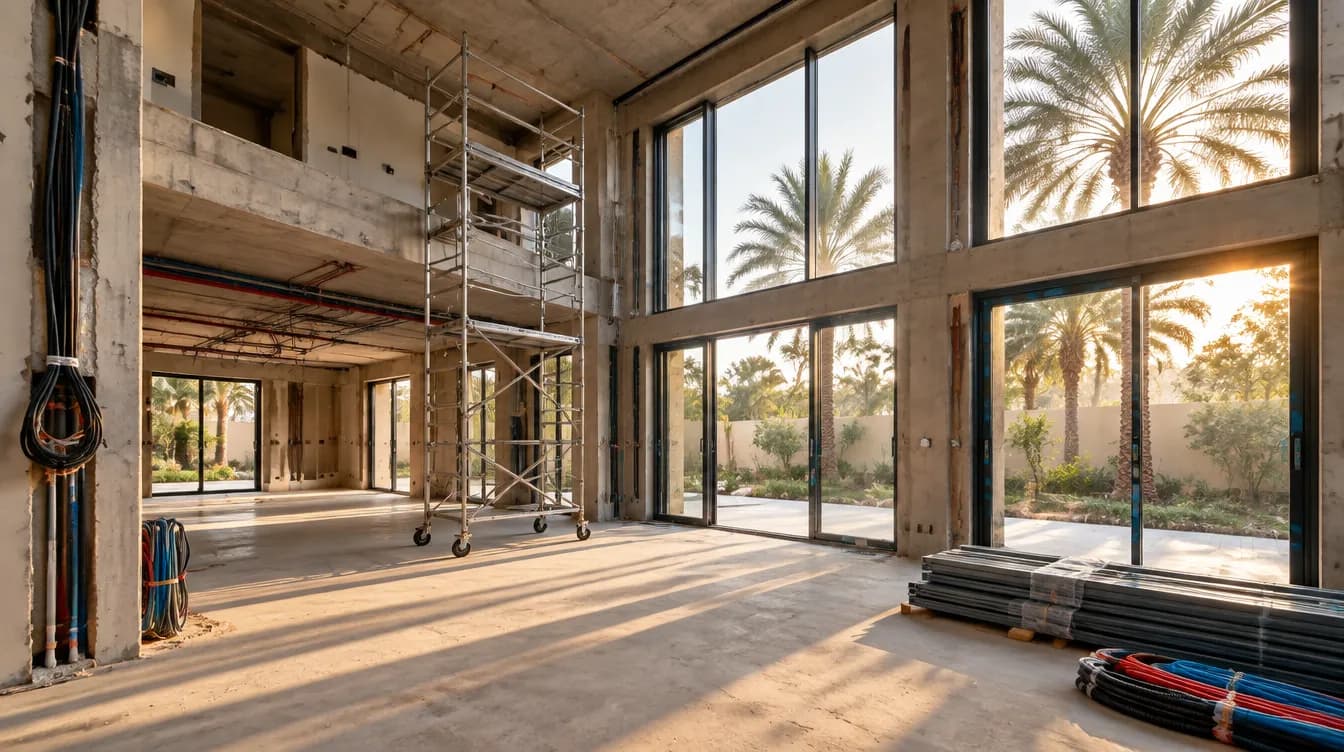
Part K asks for exposed roofs to fall between 1/50 and 1/70 towards their outlets, which on a 10 m run is a drop of about 140 mm to 200 mm. A flat patch holds water after every rain, so check the falls before the coating goes on, not after. Every parapet roof also needs an emergency overflow, so a blocked outlet does not turn the roof into a tank.
Ask the contractor to show the falls, the outlets and the overflow on a sketch before pricing, and to say whether any screed has to be relaid to make the falls work.
Then count what passes through the roof: air-conditioning supports, pipes, conduits and the hatch. DEWA's rainy-season advice for homes asks owners to seal all spare conduits on the building's roof and to keep the electrical cabinets at the entrance closed.
Each penetration is a detail the quote should list. Where people use the roof, Part K also asks for fall protection and guardrails, which have to be fixed through or around the new membrane.
Bathrooms: the membrane, the drain and the dry trap
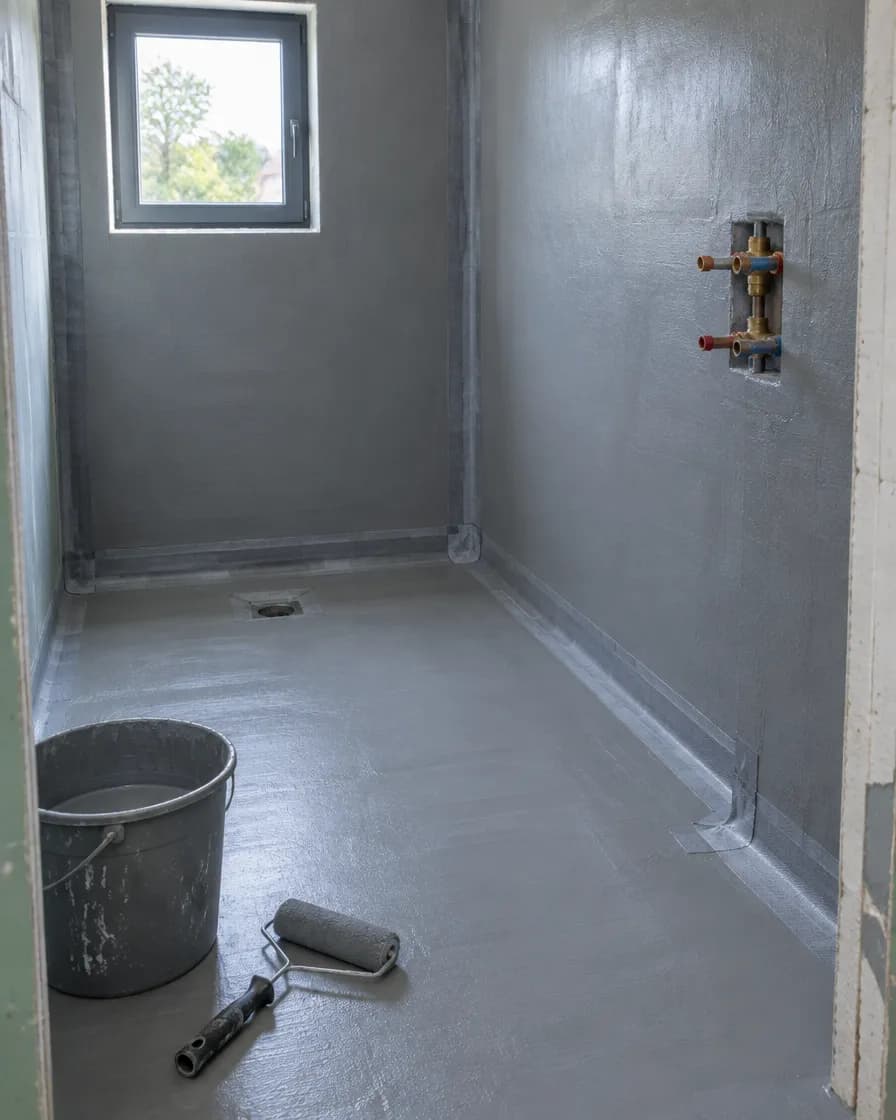
In a villa bathroom the membrane sits under the tiles, and the code sets the finish over it. Part K wants a smooth, hard, non-absorbent floor with a base at least 100 mm up the walls, walls within 600 mm of any fixture finished non-absorbent to at least 1,200 mm above the floor, and shower walls to 1,800 mm above the drain outlet.
Ask how high the membrane itself runs under those finishes, inside the shower above all.
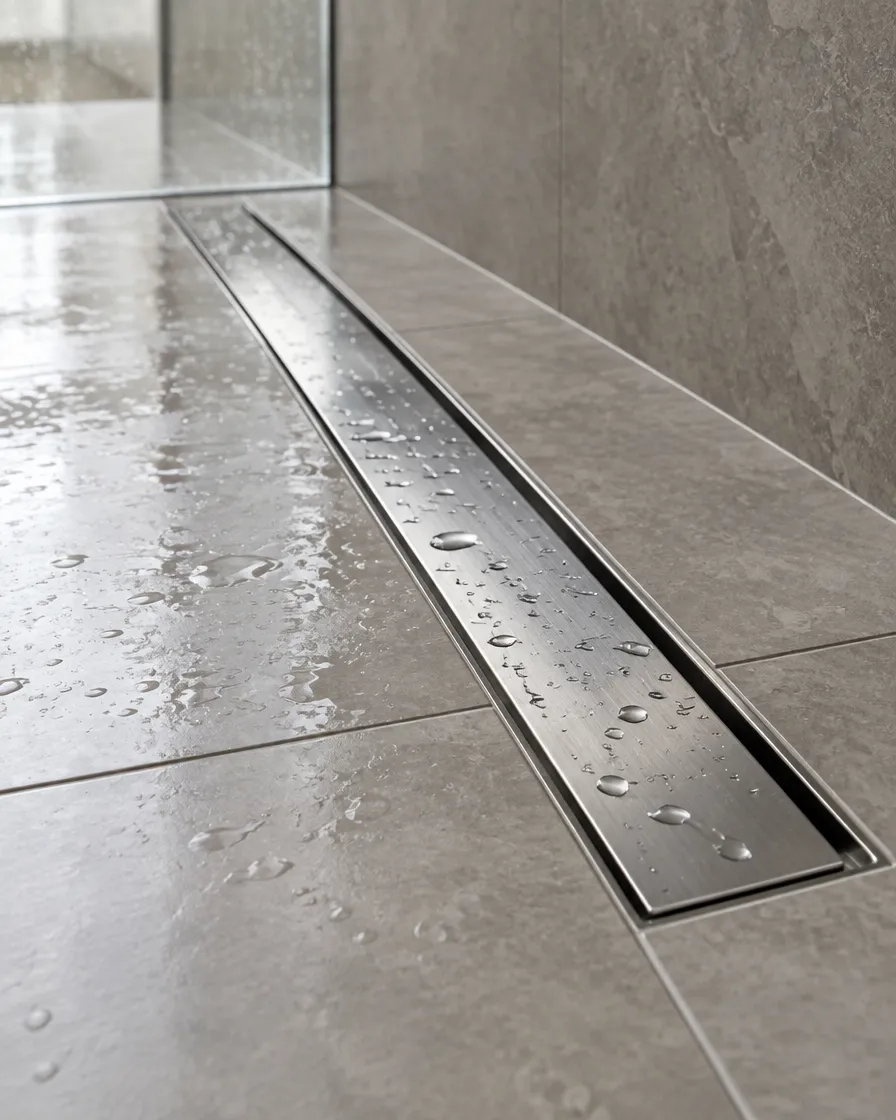
The drain is the joint the code singles out. Part K requires a waterproof seal between the floor finish and the edge of the drain grating, and a drain body chosen to suit the floor finish and the loads on it.
One more clause catches guest bathrooms. To stop trap seals drying out, Part K wants every floor drain to receive water from a fitting or an air-conditioning condensate line, or else to have an automatic trap primer. A floor drain that never sees water loses its seal. If a bathroom is redone, ask what feeds its floor drain. The rest of the room is on the bathroom renovation page.
Terraces and balconies over rooms
A terrace over a bedroom takes rain and washing water from above, and a leak shows in the room below. Part K asks horizontal and sloping surfaces in the building envelope to be jointless and impermeable, sealed at their joints, or lapped so water runs to the outer face.
In a managed community, check the finish before choosing it. Emaar Community Management tells Arabian Ranches owners that external changes which alter how the villas look are not permitted on a balcony or terrace, and points them to its Home Modification Guidelines.
The tiles that go back over new waterproofing may have to match what was there. When the terrace is one part of a wider job, the villa renovation page covers the community approvals.
A terrace over a habitable room is the case ASTM's flood test guide was written for, so ask for a flood test before the screed and tiles go back.
How to tell a proper flood test from a quick one
ASTM D5957 is the standard guide for flood testing horizontal waterproofing, written for plaza decks and similar slabs over habitable spaces, on surfaces falling no more than 2%. The membrane and its flashings have to be complete and fully cured, and the water stands no more than 100 mm deep.
The maker sets the cure time before a test, and the guide adds that no test starts in the first 24 hours after the materials go down, whatever the product.
Water also has weight: about 1 kg on each square metre for every millimetre of depth, so 50 mm of water puts about 50 kg on every square metre of slab. The guide asks for the slab's structural capacity to be reviewed by a structural engineer before the test. What a proper test looks like on site:
- Drains and outlets plugged, and the water filled to a line marked on the wall
- The start time, the depth and the finish time written down and photographed
- The ceiling and walls below checked during the test, not only at the end
- A failed test repaired and run again before anything covers the membrane
- The test run on the membrane itself, before screed and tiles, because a leak found under new tiles means lifting them
Roofs and pools: when a flood test is the wrong test
ASTM D5957 says it is not intended for roofing systems, nor for pools, fountains or other surfaces kept under water for long periods. For those, ASTM D7877 describes electronic leak detection: a test current across the membrane locates the breach, on exposed or covered membranes, in roofs, plaza decks, pools and water features.
It has one condition to plan before the membrane goes down. The method needs a conductive surface under the membrane to carry the test current back. Where the membrane sits on insulation or a protection board, ASTM's remedy is a conductive layer placed directly under the membrane. ASTM also says the method works alongside visual and infrared inspection rather than replacing them.
For a pool shell, the guide to choosing a pool company covers the waterproofing warranty letter to ask for.
What to ask before you sign
When you are ready for an inspection and a quote, the waterproofing company in Dubai page explains how we match you with a partner contractor for the job.
Check that the trade licence's activities cover the work, and ask for the firm's entry in Dubai Municipality's contractor register. Article 5 of Dubai Law No. 7 of 2025 bars individuals and companies from contracting with a company for contracting work unless it holds a trade licence and is entered in that register.
Dubai Municipality's model construction contract for private villas sets the paperwork worth asking for. It has the contractor carry out every test that proves the work, hand over warranty letters for all the waterproofing, naming basements, roofs, kitchens, bathrooms and swimming pools, at completion, and repair defects through a defects period after handover. A standalone waterproofing job deserves the same in writing.
- What did the inspection test, and what did it rule out, a supply pipe included?
- Which product, how many coats and what thickness, with the maker's data sheet?
- How are the falls, outlets, overflows and every penetration detailed?
- When is the flood test, how deep, for how long, and who checks the room below?
- Who issues the warranty letter, the applicator or the maker, what does it cover and for how long?
- Is the 5% VAT included in the price?
Questions
How do I know if a leak is a pipe or the waterproofing?
Watch when it appears. A patch that stays wet when nothing has been used may be a pipe under pressure, which DEWA's High Water Usage Alert, the bill or the water meter can point to. A stain that appears after rain or after a shower is used points at the membrane or the drain.
Can a roof be flood tested?
ASTM D5957, the flood test guide, says it is not intended for roofing systems. ASTM D7877 describes electronic leak detection for roofs instead. Where the membrane sits on insulation, the method needs a conductive layer under it, so plan the test before the membrane is laid.
What fall should a villa roof have in Dubai?
Part K of the Dubai Building Code, clause K.10.3.4.3, asks for exposed roofs and canopies to fall at no more than 1/50 and no less than 1/70 towards channels, gutters or outlets, and for every parapet roof to have an emergency overflow.
How deep should the water be in a flood test?
No more than 100 mm, under ASTM D5957, on a membrane that is complete and fully cured and never in the first 24 hours after it goes down. Check the depth and the duration against the data sheet of the product on your quote; the waterproofing company page gives one maker's figures.
Do I need a NOC to redo terrace waterproofing in Dubai?
Check your community's rules first. In Arabian Ranches, Emaar Community Management requires its approval for any alteration to a villa and does not permit external changes that alter how villas look on a balcony or terrace, so the finish over new waterproofing may need to match the old one.
Who signs the waterproofing contract?
The partner waterproofing contractor, who does the work and gives any warranty. Dubai Renovations is not a party to the contract, the payments or the warranty.