
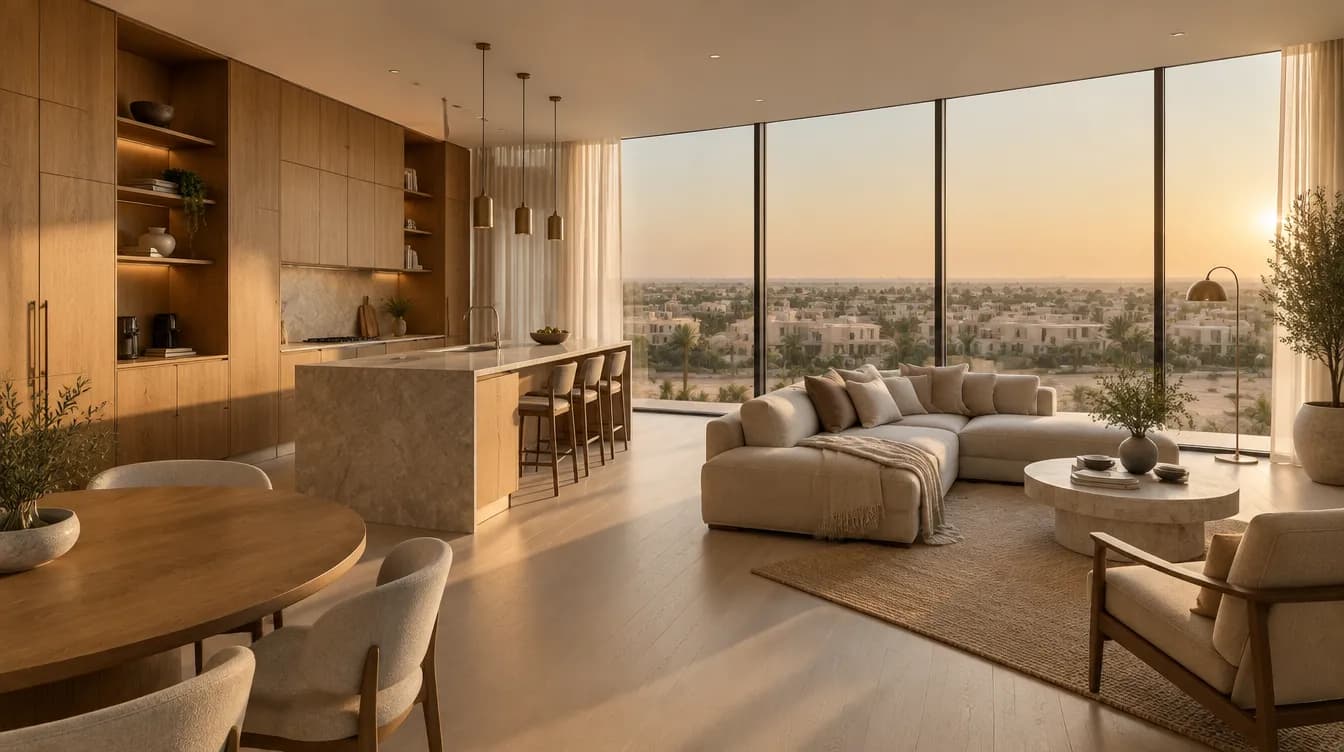
Flooring company in Dubai, matched to your floor
Tile, vinyl, engineered wood or stone. Describe the rooms and a partner flooring contractor visits, measures, quotes and signs the contract with you.
A flooring company in Dubai supplies and lays porcelain tile, stone, click vinyl, laminate, wood or carpet over a floor it has checked first. Dubai Renovations takes your enquiry and briefs a partner flooring contractor, who visits, measures, quotes in writing, signs the contract with you and lays the floor. Three things decide the job: what sits under the old floor, how much height the doors and ceilings can give up, and whether the room gets wet.
A new floor sits on everything beneath it. A screed laid while still damp, grout lines left proud under a click floor, or wood delivered before the air conditioning ran can each show up months later as gaps, lifting or hollow tiles. This page sets each floor type against the room it suits, the limits printed in the makers' own data sheets and installation instructions, what the Dubai Building Code says about wet rooms and slip resistance, and what a written flooring quote should list.
What does a flooring company in Dubai do?
Two different things are sold under the same name. Most of the first page of results for this search is showrooms: tile, vinyl and wood sold by the square metre, with a discount in the headline and installation mentioned as an extra. Installation carries most of the risk, because that is where the subfloor gets checked, levelled and primed, the adhesive or underlay is chosen, and the gaps, thresholds and skirtings are worked out.
Dubai Renovations briefs a partner contractor for the installation. The partner can supply the material, or lay one you have bought, and either way the quote should say which. If you are buying the material yourself, buy the whole quantity in one order, because tiles and planks are made in batches and a second order can come back a shade out.
What types of flooring are available in the UAE?
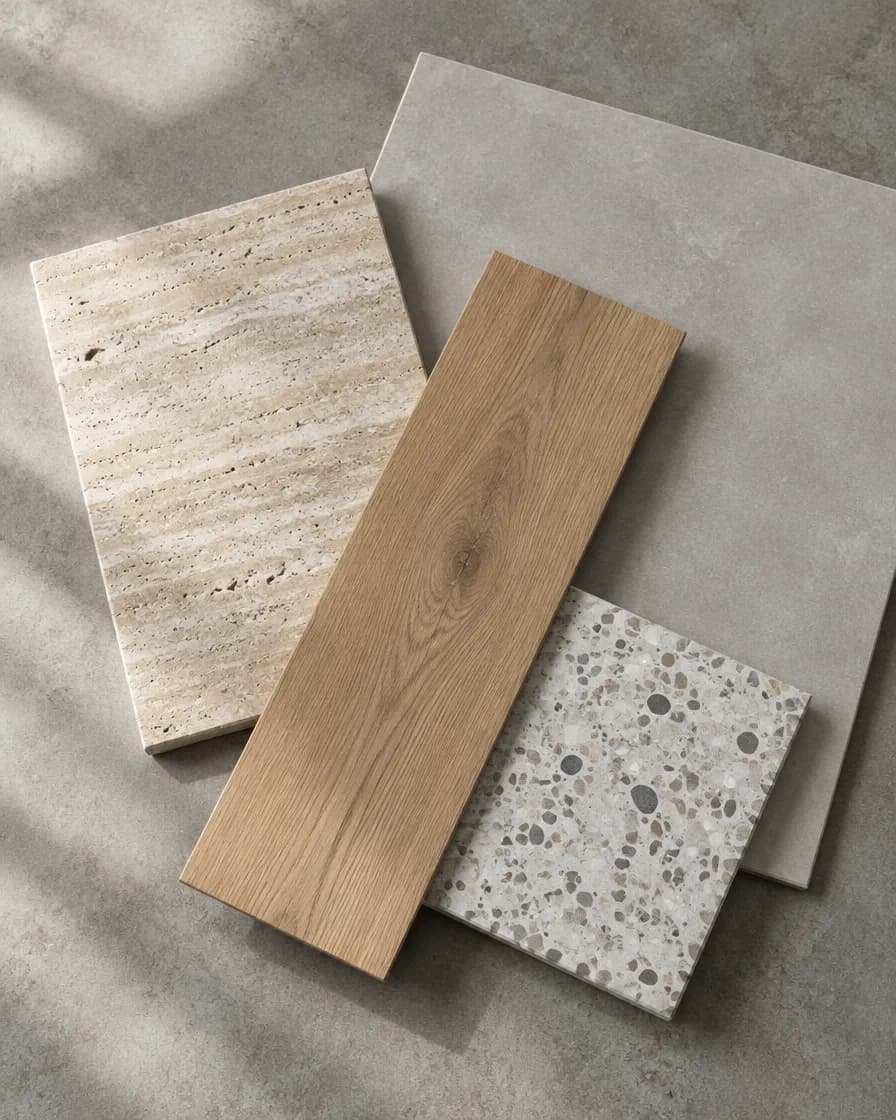
Six families of floor cover almost every home in Dubai, and each one comes with a maker's rule that decides where it can go. The table puts them side by side with the published limit most worth checking before you choose.
Laminate and click vinyl look alike, and both click together and float on the subfloor. The difference that matters in a Dubai home is water: the vinyl maker cited here rates its floor as water resistant, and even so it excludes shower enclosures and rooms with built-in drainage.
| Floor | Where it suits | What goes underneath | A published limit worth checking |
|---|---|---|---|
| Porcelain or ceramic tile | Any room, including bathrooms, kitchens and terraces | Cement-based tile adhesive on a cured, sound screed | Sika's SikaCeram-214 Premium, an EN 12004 class C2 TE adhesive, is rated for +5 to +35 °C and is not for porcelain tiles longer than 60 cm on a side |
| Large-format porcelain | Living areas where you want few joints | A deformable adhesive, EN 12004 class S1, on a flat screed | Sika's SikaCeram-255 Starflex SA is class C2 TE S1 and uses a 10 mm notched trowel for large tiles |
| Click vinyl (SPC or LVT) and laminate | Bedrooms, living rooms, and apartments laid over existing tiles | A flat, dry subfloor; the floor floats | Quick-Step's click vinyl instructions ask for an 8 mm expansion gap, and levelling of any dip over 1 mm across 20 cm |
| Engineered or solid wood | Rooms that stay air-conditioned all year | Glued or floating over a dry screed | The National Wood Flooring Association puts solid wood's comfortable range at 30% to 50% relative humidity |
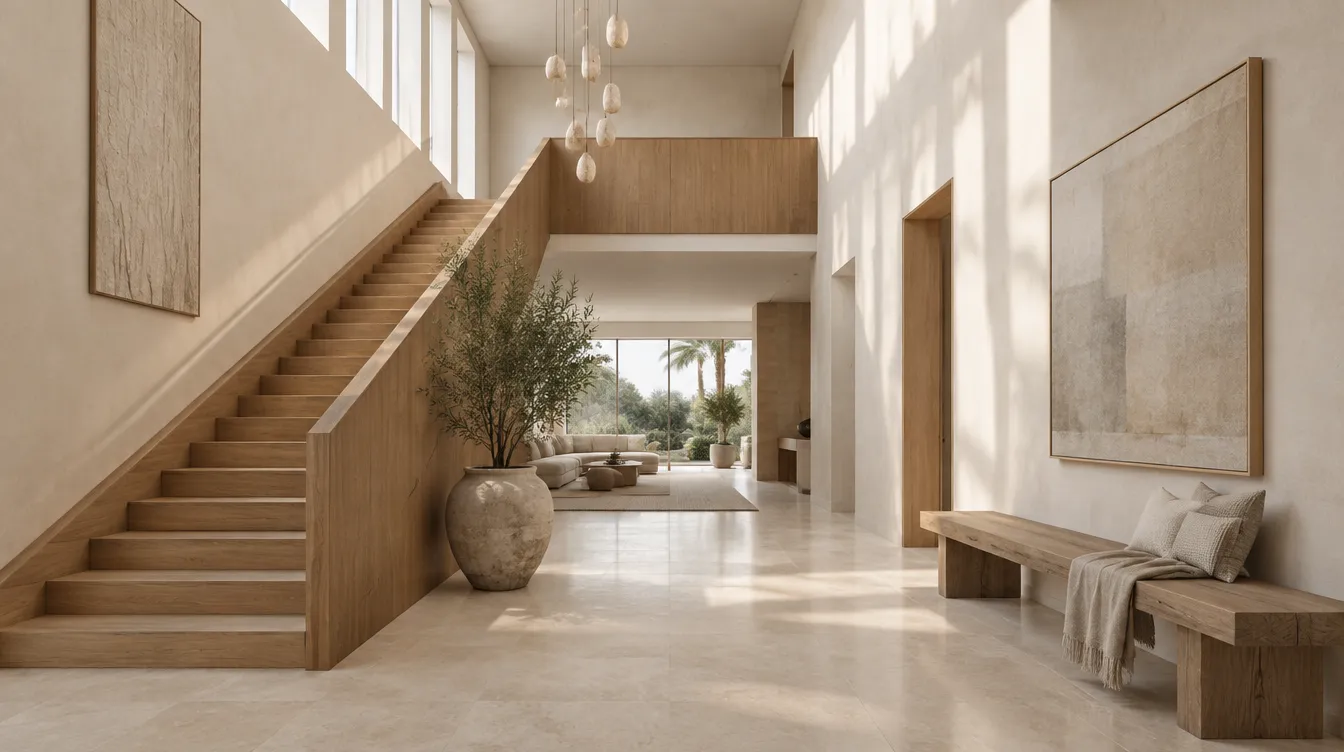
| Natural stone | Entrances, halls and staircases | An adhesive rated for moisture-tolerant stone | Sika's adhesive sheet asks for a test area before any work with natural stone |
| Carpet | Bedrooms and a majlis | Underlay and grippers, or adhesive | The Dubai Building Code requires carpet systems to be certified by Dubai Central Laboratory or another laboratory the authority approves |
Sources
- SikaCeram-214 Premium product data sheet, April 2024, version 01.02 (Sika)
- SikaCeram-255 Starflex SA product data sheet, May 2022, version 03.01 (Sika)
- Installation instructions for Quick-Step Alpha Vinyl Pad, version 11.2025 (Quick-Step)
- Wood Flooring Installation Guidelines, revised 2025 (National Wood Flooring Association)
- Dubai Building Code, 2021 edition (Dubai Development Authority)
How much does flooring cost in Dubai?
Dubai Renovations does not publish a flooring price. This site shows a price only when a named publisher gives it for the same product and the same installation, and no source we could check met that bar. What we can set out is what moves the number, so two quotes can be read on the same footing.
The floor that costs least per square metre is not always the cheapest job. A floating click floor laid over sound existing tiles skips demolition and debris removal, while a new tile floor usually starts with the old one coming up. Preparation is priced on top of the material: levelling compound, primer, a damp-proof membrane on a ground floor, new skirting, and doors trimmed to clear the new height.
- The measured floor area, room by room, and the cutting waste the quote allows for
- Removal and disposal of the old floor, or the reason it can stay
- Levelling, priming and any damp-proof membrane, as measured items
- The adhesive or underlay by product name and class
- Skirting, thresholds, expansion profiles and door trimming
- Moving furniture and protecting the rooms and fittings that stay
- Whether 5% VAT, charged in the UAE since 1 January 2018, is inside the total
How much flooring does 1,500 sq ft need?
1,500 sq ft is about 139 m², and the data sheets turn that into quantities you can check against a quote. For tiles, Sika gives the consumption of its deformable adhesive SikaCeram-255 Starflex SA as about 6 kg/m² for large tiles on a 10 mm notched trowel and about 3.5 kg/m² for medium tiles on an 8 mm trowel. Across 139 m² that is roughly 836 kg for large tiles, about 34 bags of 25 kg, or roughly 488 kg for medium ones. Sika notes these figures are theoretical and leave out porosity, uneven substrates and wastage.
For click vinyl the limit is shape, not area. Quick-Step sets a maximum room size of 13 m by 13 m for ordinary residential use between 15 and 35 °C, so 139 m² fits, but a through living and dining room longer than 13 m needs an expansion profile somewhere along it. In a room whose temperature swings between 5 and 65 °C the limit drops to 8 m by 8 m.
Put those quantities beside the quote: the area, the product and how much of it, and the preparation before any of it goes down.
The subfloor comes first
Flooring makers set moisture limits, and a screed that looks dry can still be over them. Quick-Step's instructions for its click vinyl require a cement screed below 2.5% by the carbide (CM) method, equal to 75% relative humidity, and an anhydrite screed below 0.5%. They also give the drying time for new screed: at least one week per centimetre up to 4 cm, and twice that beyond, so a 6 cm screed needs at least eight weeks. The same instructions say to measure, record and keep the readings, which is a fair thing to ask a partner to hand over.
Flatness has numbers too. Quick-Step asks for any dip or bump over 1 mm across 20 cm, or over 4 mm across 2 m, to be levelled before the floor goes down. On a tiled floor, grout joints deeper than 2 mm and wider than 5 mm count as gaps and are filled first, or the lines print through the new floor.
A ground floor has a damp question of its own. The Dubai Building Code asks for a damp-proof course at least 150 mm above the adjoining ground, continuous with any damp-proof membrane in the floor, and it describes Dubai's groundwater as saline and very aggressive to concrete. Quick-Step, for its part, requires an effective damp-proof membrane on any mineral subfloor laid directly on the ground. Ask the partner what is under a villa's ground-floor slab before choosing wood or vinyl for it.
Can new flooring go over existing tiles?
Often, if the old tiles are sound. Tap them first: a hollow sound means a tile that has lost its bond, and anything laid on top inherits the problem. Sika's adhesive sheet allows tiling over existing ceramic tiles once they are confirmed firmly bonded and stable and have been degreased and descaled, but not over old outdoor ceramic tiles. Quick-Step allows its click vinyl over tiles once the deep, wide grout joints are levelled.
The new floor raises the room. New tiles plus adhesive, or a click floor with its underlay, raise the floor, so doors get trimmed and the skirting usually comes off and goes back on new. The Dubai Building Code's minimum clear height of 2.7 m in living rooms and bedrooms is measured from the finished floor, so a room already close to it can drop below once the floor rises and a new ceiling comes down as well.
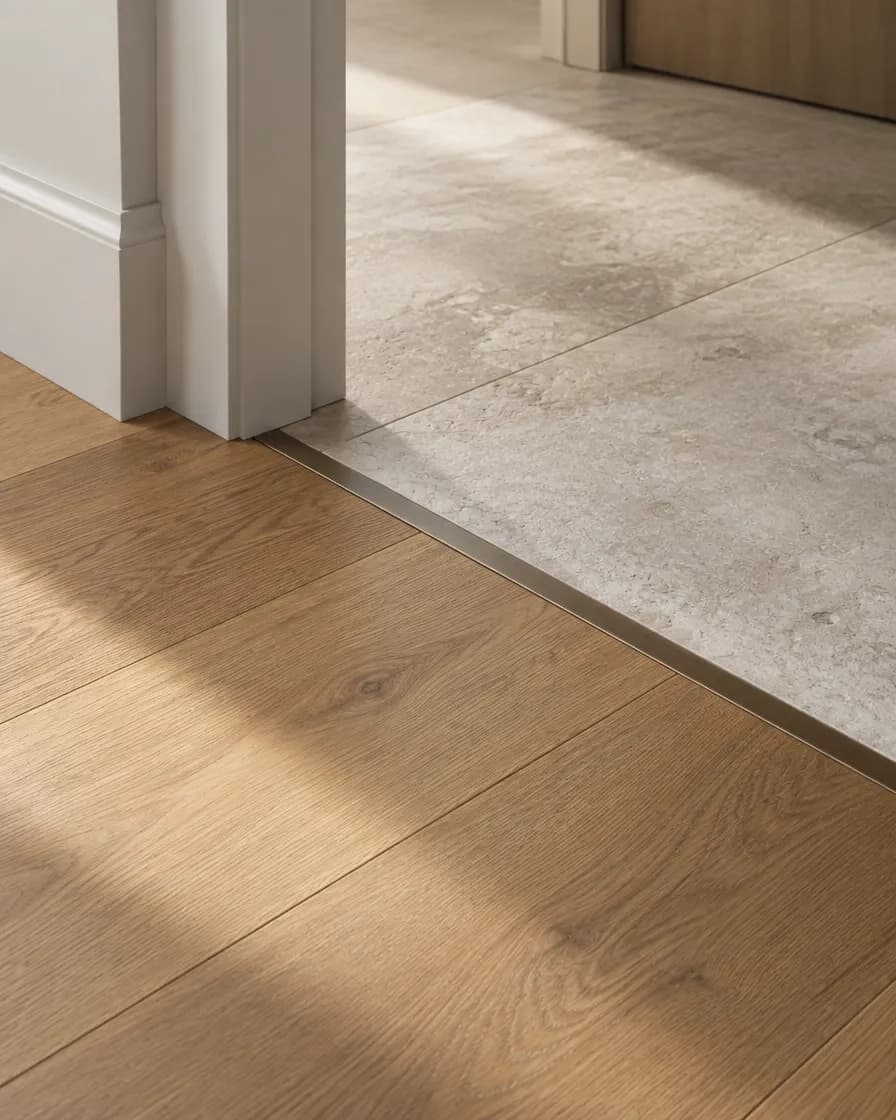
Thresholds matter where the new floor meets one that stays. The code's accessibility part, which covers accessible routes and common areas rather than private homes, allows a change in level of up to 13 mm with a bevel no steeper than 25%, with anything higher ramped or kept to a 5% slope. In a home it is a sensible benchmark. A partner planning a floor through part of a flat should show where each threshold falls and what profile covers it.
Slip resistance: what the code asks for
The Dubai Building Code measures slip resistance with a pendulum test to BS EN 13036-4, and the result is a pendulum test value (PTV). Table C.19 sits in Part C, which applies to the common parts of apartment buildings and to accessible units, not to villas or individual homes. It sets the level by where the floor is and how steep it is, and the code says the values must allow for both shod and barefoot users. It also puts the duty on the product provider to give the PTV, and says a material without one should be tested in a laboratory before it is accepted.
For villa bathrooms, Part K asks for a floor finish that is smooth, hard and non-absorbent, and for the floors of showers and other fixtures to be non-slip. Polished porcelain that looks right in a living room can be the wrong tile for a shower tray, so ask for the PTV of the exact tile before it is ordered.
| Where | Floor slope | Pendulum test value (PTV) |
|---|---|---|
| Indoor, dry | Level, or a slope under 5% | Between 15 and 35 |
| Indoor, dry | 5% or steeper | 35 or more |
| Outdoor and wet areas | Level, or a slope under 5% | Between 35 and 45 |
| Outdoor and wet areas | 5% or steeper | 45 or more |
| Street paving, swimming pools and showers | Any | 45 or more |
Wood and vinyl in Dubai heat and humidity
A wood floor moves with the humidity the air conditioning holds. Part K of the Dubai Building Code requires villa systems to be capable of holding 22.5 to 25.5 °C and 30% to 60% relative humidity for 95% of the year. The National Wood Flooring Association's 2025 guidelines put the general range for solid wood at 30% to 50% relative humidity, and add that some makers build for wetter or drier regions. So a system that meets the code can still run the air wetter than a wood floor likes. The maker's own range is the one to hold the partner to.
Timing counts as much as the numbers. The same guidelines say wood flooring should be one of the last jobs on a renovation, and should not be delivered until the building is closed in, with windows, doors and roof finished. A villa left shut with the air conditioning off through a Dubai summer is not a place to store or fit a wood floor.
Click vinyl has limits of its own. Quick-Step asks for its boxes to acclimatise in the room for at least 48 hours at 18 to 30 °C, with the subfloor above 15 °C, and for that temperature to hold during fitting and for 24 hours after. Kitchen islands and built-in wardrobes go in first and the floor stops short of them, because a floating floor pinned under a heavy fixture opens at the joints. For spots that get very hot, the same maker points to its glue-down vinyl instead.
Tiles and adhesives: what the quote should name
A tile quote that names no adhesive is not finished. EN 12004 classes cement-based tile adhesives, and the class printed on the bag tells you what it is built for. Sika's SikaCeram-214 Premium is class C2 TE, and its sheet lists extended open time and no sagging among its features; the same sheet rules it out for porcelain tiles longer than 60 cm on a side. For those, the deformable class S1 is the relevant one: SikaCeram-255 Starflex SA is C2 TE S1, with a transverse deformation of 2.5 mm.
Both sheets give the same timetable: floor tiles grouted after 24 to 36 hours, wall tiles after 4 to 6 hours, and full traffic or use after 14 days. Moving furniture back onto a new tiled floor two days after it went down is inside that window. Both are rated for air and substrate temperatures of +5 to +35 °C, and both ask for an absorbent substrate to be dampened in hot conditions, with no water left standing, just before the adhesive goes on.
Can vinyl or laminate go in a bathroom?
Not in the wet part of it. Quick-Step's instructions say its click vinyl is not suitable for shower enclosures, pool areas, saunas or rooms with built-in drainage, and note that some national rules do not allow floating floors in wet rooms at all. Part K of the Dubai Building Code asks for a floor drain in every area with wet sanitary fittings, so a villa bathroom built to the code is, by definition, a room with built-in drainage.
Tile remains the floor for bathrooms, laid over a waterproofing membrane that turns up the walls. The waterproofing company in Dubai page covers the membrane and the flood test, and the bathroom renovation page covers the rest of the room.
Flooring in an apartment
Inside the unit, the floor is yours to change under building management's renovation rules and its NOC. Expect permitted working hours, a booked service lift for boxes and bags of adhesive, and protection for the corridor. If you rent, Article 19 of Dubai Law No. 26 of 2007 says a tenant may not carry out changes without the landlord's permission, so get that in writing before booking anything.
The Dubai Building Code also covers what the floor gives off. Part K requires adhesives and sealants in a villa to stay within the volatile organic compound limits set by Dubai Central Laboratory and to be certified by it or another approved laboratory, and Part H applies the same rule to air-conditioned buildings generally. Ask which adhesive is named, and whether its certificate is in hand. The apartment renovation page covers the NOC and what a tower lets you change.
How do you judge a flooring company?
Size is the wrong test, and so is a place on a top-ten list. The largest showroom in the city can still lay a click floor on a screed nobody measured. The flooring contractor worth hiring is the one whose quote shows the checks were done. A written quote you can hold a partner to names each of these, or says plainly that it is left out:
- The moisture reading of the screed, how it was taken, and the maker's limit it was checked against
- The flatness check, and the levelling priced as a measured item
- The floor product, its batch, and the adhesive or underlay by name and class
- Expansion gaps, the profiles that cover them, and where each threshold falls
- The PTV of any tile going into a wet room or outdoors
- Removal of the old floor, door trimming, and new skirting
- When furniture can go back, from the adhesive maker's timetable
- Whether 5% UAE VAT is included
Flooring as part of a bigger renovation
On a renovation, floors go down late. The home renovation page lists the order: first fix, plastering and gypsum ceilings, waterproofing in wet areas, then tiling and flooring, then joinery and paint. A floor laid before the ceiling trades finish tends to get damaged under their ladders. When new flooring is one line among ceilings, lighting and joinery, the job is an interior renovation.
What to send with your flooring enquiry
A partner contractor can plan the visit from these details:
- Villa, townhouse or apartment, the floor level, and the community or building
- Which rooms, their rough sizes, and a photo of each floor
- The floor you have now, and whether any tiles sound hollow or have cracked
- The floor you want, or two you are choosing between
- Whether the home is empty or furnished, and whether you own it or rent it
Questions
How much does flooring cost in Dubai?
Dubai Renovations does not publish a flooring price, because no source we could check prices the same product and installation with a named publisher. The total rests on the area, the removal of the old floor, levelling and priming, the adhesive or underlay, skirting and thresholds, and VAT. A partner contractor quotes in writing after measuring.
Can I lay new flooring over my old tiles?
Often, if the old tiles are firmly bonded. Hollow-sounding tiles come up first, deep grout joints are filled, and the extra height means trimming doors and refitting skirting. Sika's adhesive sheet rules out tiling over old outdoor ceramic tiles.
How soon can I walk on a new tiled floor?
Sika's data sheets for its C2 tile adhesives give grouting of floor tiles after 24 to 36 hours and full traffic or use after 14 days. Ask the partner for the timetable of the adhesive named on your quote.
Is engineered wood a good choice in Dubai?
In rooms that stay air-conditioned, yes, if the humidity is held inside the maker's range. The National Wood Flooring Association puts solid wood's general range at 30% to 50% relative humidity, while the Dubai Building Code lets villa air conditioning run up to 60%.
What is the cheapest flooring to install?
Usually the one that needs the least preparation. A floating click floor over sound existing tiles avoids demolition, while new tiles usually mean lifting the old ones. The price of the material per square metre is only part of the total.
Who signs the flooring contract?
You sign with the partner contractor, who lays the floor and stands behind it. Dubai Renovations is not a party to the contract, the payments or any warranty. For a wider job, see interior renovation.
Send the job on WhatsApp
Choose what fits and WhatsApp opens with the message written. Add a photo of each room in the chat.