
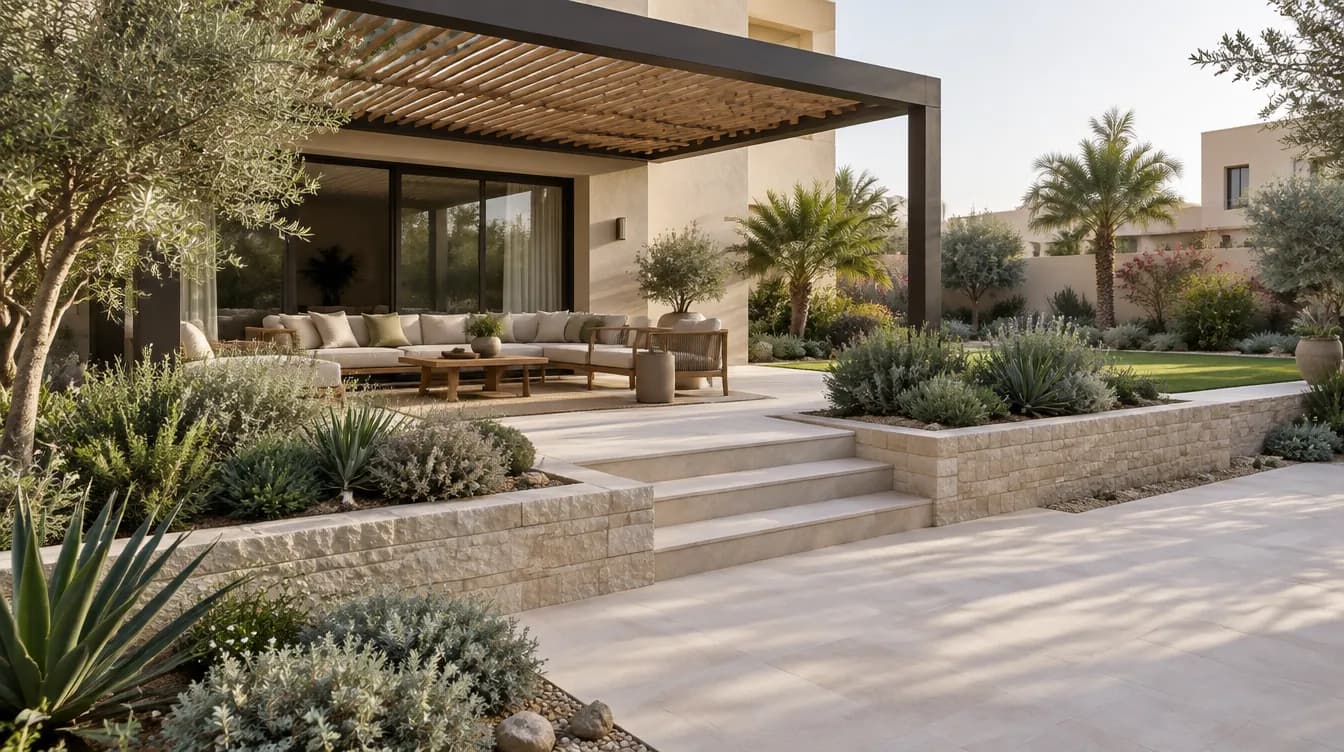
Pergolas in Dubai
Aluminium, timber or louvred, over a terrace, a pool deck or a roof. A partner contractor visits, quotes and signs the contract with you.
A pergola in Dubai shades a terrace, a pool deck or a roof, and the Dubai Building Code treats it more lightly than almost anything else on a villa plot. It is left out of built-up area and plot coverage, and it may stand inside the setback right up to the plot limit. Dubai Renovations takes your enquiry and briefs a partner contractor, who visits, quotes, signs the contract with you and installs it.
Much of what is sold as a pergola in Dubai is a kit, priced by the piece or by the square metre. This page is about an installed one: the rules that decide where it can stand, how the roof type changes what you are buying, what wind and heat do to it, and what to ask before anything is fixed to the ground.
What the Dubai Building Code says about a pergola
The code defines a pergola as a shading device using solid material, normally used for ornamentation or for shading. That short definition carries more weight than it looks, because four separate rules on a villa plot name pergolas and treat them as lighter than a room.
Built-up area, defined in A.5.2.2, excludes lightweight outdoor shading structures such as pergolas and standalone canopies. Plot coverage, in K.5.2.7, excludes lightweight structures such as canopies, parking shades and pergolas. And K.5.2.4 lists pergolas and lightweight parking shading structures among the few things allowed inside the setbacks, all the way to the plot limit. The villa extension page sets those same rules against a room, which gets none of the three.
The roof is where the code gets less definite. Part B, which sets the general rules for buildings, lists pergolas and roof shading devices among the parts of a building that may exceed the maximum allowable height, provided that does not conflict with Dubai Civil Aviation Authority or DCR requirements. Part K, the villa part, has no matching clause, and it limits structures on a villa roof to 50% of the roof floor area, set back at least 1.5 m from the facade, and does not say whether a roof pergola counts inside that 50%. On a roof terrace, get the consultant's reading of that in writing before the design is fixed.
| Rule | What the code says | What it means for your plot |
|---|---|---|
| Built-up area, A.5.2.2 | Excludes lightweight outdoor shading structures such as pergolas and standalone canopies | A pergola does not use up the built-up area left on the plot |
| Plot coverage, K.5.2.7 | Excludes lightweight structures such as canopies, parking shades and pergolas | It does not count against the ground the villa and any annex may cover |
| Setbacks, K.5.2.4 | Pergolas and lightweight parking shading structures are allowed within setbacks up to the plot limit | It can run to the boundary where a new room could not |
| Building height, B.4.2.2 | In Part B's general rules, pergolas and roof shading devices may exceed the maximum allowable height where this does not conflict with DCAA or DCR requirements | Part K, the villa part, has no matching clause, so the plot's DCR decides a roof pergola's height |
| Roof structures, K.5.2.8.3 | Structures on the roof may cover no more than 50% of the roof floor area and sit at least 1.5 m back from the facade | The code is silent on whether a roof pergola counts inside the 50%, so ask |
When a pergola stops counting as a pergola
The exclusions are worded carefully, and the words are lightweight and standalone. Built-up area counts balconies, terraces, covered parking and any other covered spaces, and any other permanent structures on the plot. A slatted or louvred roof on its own posts sits on the excluded side of that line. A solid roof carried on the villa's own structure, with walls or glazing added underneath, has become a covered space.
That is the point where the job changes kind. An enclosed terrace is an addition under the code, with a consultant, structural drawings and an authority permit, and it uses up the built-up area a pergola did not. If the plan is to close a pergola in later with glass or screens, say so at the first visit, because the partner designs the posts, the fixings and the approvals differently for a structure that will one day be a room.
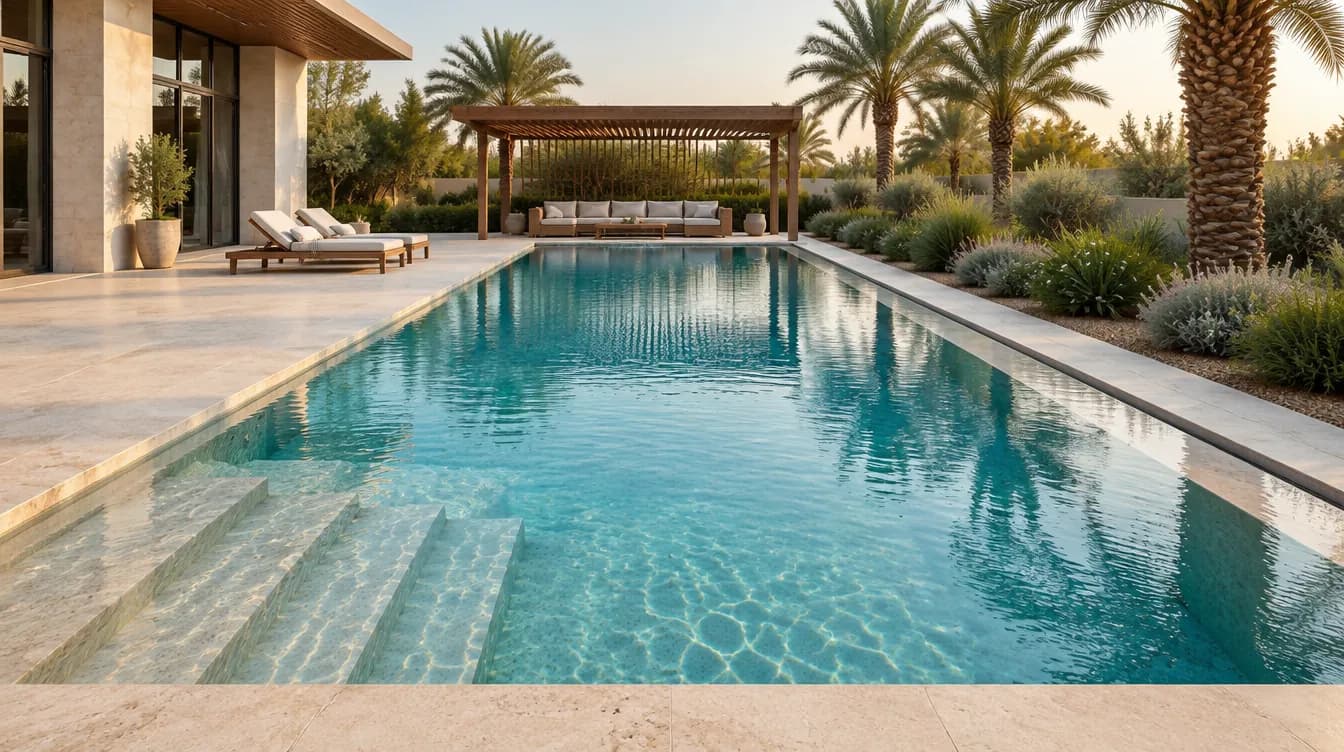
Choosing the roof: fixed slats, louvres, fabric or solid
The roof decides how a pergola behaves in sun, wind and rain. The frame under it is a set of posts and beams whichever roof you choose. The questions below are the ones that separate the roof types at the quote stage.
A solid roof has one rule the others avoid. The Dubai Building Code asks for exposed roof areas and canopies on a villa to fall at no more than 1 in 50 and no less than 1 in 70, directing rainwater to channels, gutters or outlets, and for rainwater pipes to discharge above ground rather than into the sewer. A pergola roof that sheds water needs somewhere to put it.
| Roof | How it shades | What to ask about it |
|---|---|---|
| Fixed slats, aluminium or timber | Permanent part shade; slat spacing and direction set how much sun comes through | Which way do the slats run against the sun's path over this terrace? |
| Rotating louvres, often sold as bioclimatic | Blades turn to shade, ventilate or close against rain | What wind speed is it rated for with the blades open and closed, and where does the water drain? |
| Retractable fabric | Opens fully or closes to shade | What wind speed must it be retracted at, and does it retract on a sensor or by hand? |
| Solid panels | Full shade and rain cover | What fall does it have, where do the gutters discharge, and does it now count as a covered space? |
What one louvred roof maker publishes, and why you should ask for it
Makers of louvred roofs publish test figures, and asking for them is the fastest way to compare two quotes that look the same. Renson's product information for its Algarve louvred roof is a useful example of what that sheet should contain. It gives a wind guarantee of up to 120 km/h with the blades closed and no figure with them open, and says operating the blades is only permitted up to 50 km/h, because above that the blades may start vibrating. Its optional side screen, the Fixscreen, carries its own guarantee of up to 60 km/h when closed.
The same sheet puts load-bearing capacity at 100 kg/m² and water drainage at 120 l/m²/h, and warns that with only one column draining, capacity drops to 0.025 l/m² a second, 90 litres an hour. For scale, the Dubai Building Code designs a villa's paved-area drainage for a rainfall intensity of 65 mm an hour, and 1 mm of rain on a square metre is 1 litre. A single roof section, with an intermediate beam, spans up to 6 x 6 m without an intermediate column. The blade drive runs from a 230 V supply through a 24 V DC motor. Among its documents the maker lists a wind load testing certificate and a seaside and coastal powder coating guarantee, which is the document to ask for on a villa near the water.
Then set the product against the code. Part K has villa structures designed for wind to ASCE/SEI 7-16 using Dubai's own reference speeds: 47 m/s for strength, risk category II at a 700-year return period, 30 m/s for serviceability deflections, and never less than 1 kN/m² of design wind pressure. A maker's km/h rating and the code's reference speed are not the same measure, so neither number proves the other. Ask who checked the posts, the base plates and the fixings into the villa wall against the code's figures, and ask to see that calculation.
Heat, colour and the metal in a Dubai summer
The code's own design figures describe the conditions a pergola lives in. Part K designs cooling for an outdoor dry bulb temperature of 46 °C, and requires electrical equipment to perform at a maximum outdoor ambient temperature of 48 °C in the shade. A pergola is not in the shade. Its motor, its sensors and its lighting drivers sit in the sun, so ask for each one's rated operating temperature, not just the frame's.
Metal moves with heat, and the code says so. Part K lets protected steel take a default thermal range of ±25 °C, but for exposed steelwork it says the range can come from hourly maxima and minima and has to be assessed case by case. A long steel or aluminium beam fixed hard to a villa wall at both ends has to be allowed to move somewhere.
Colour is a code question as well as a taste one. At least 50% of a villa's hardscape has to reach a solar reflectance index of at least 29, use an open grid pavement system, or be shaded by vegetation, by solar panels, or by materials meeting the envelope figures in K.7.2.7: an index of 78 for a flat or low-sloped surface, 1 in 6 or flatter, and 29 for a steeper one. A pergola over a terrace counts as that shade only if its roof reaches those numbers, and a flat louvred roof is on the 78 side. Ask for the solar reflectance index of the exact finish being quoted, because two colours on one sample card can land either side of the line.
Lighting under the roof has a rule too. Part K asks for exterior landscape lighting to be aimed or shielded so it does not light the night sky or neighbouring plots. Uplights washing the underside of the slats are fine; a floodlight on a post aimed across the boundary is not.
Where the pergola goes: terrace, pool, roof or barbecue
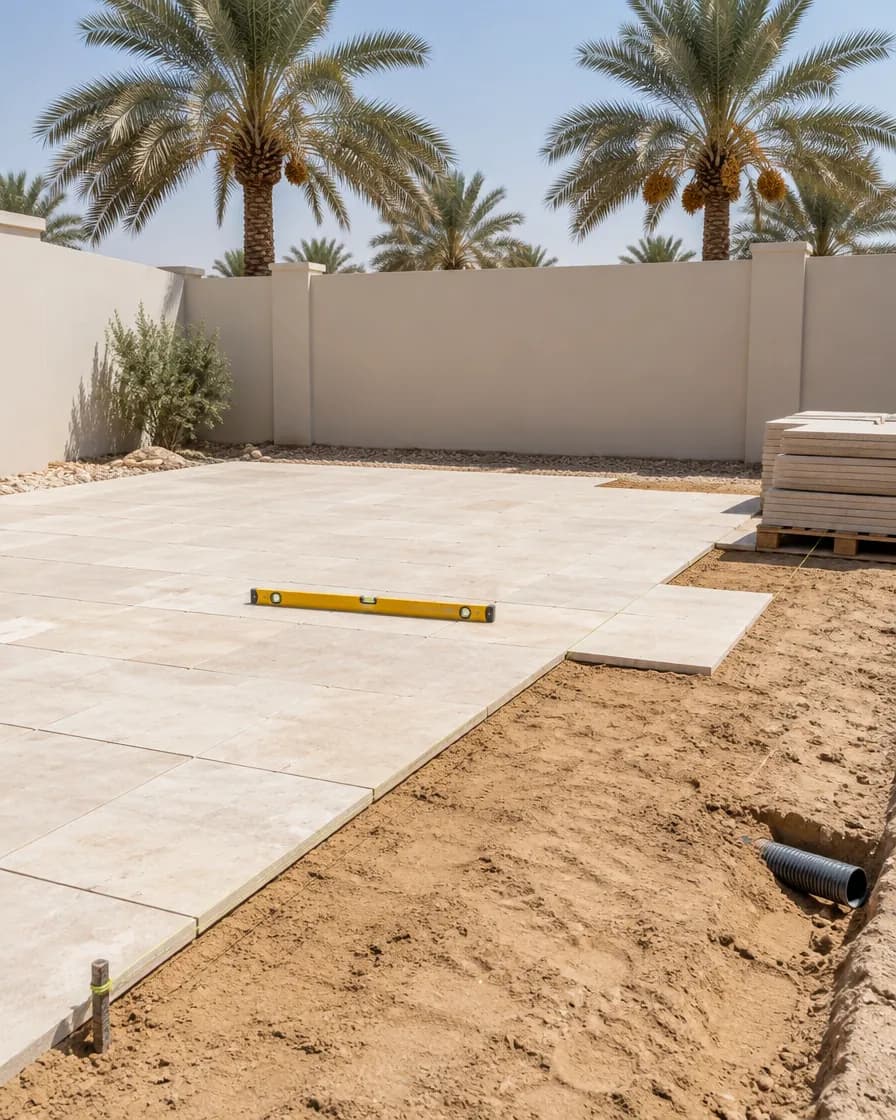
Over a terrace against the house, the questions are fixings and drainage: what the ledger beam bolts into, and where the water off the roof goes once it is past the house wall. Freestanding in the garden, the question is footings, because a pergola on its own posts needs a base that will not move, and the partner decides whether that is the existing slab or new pads.
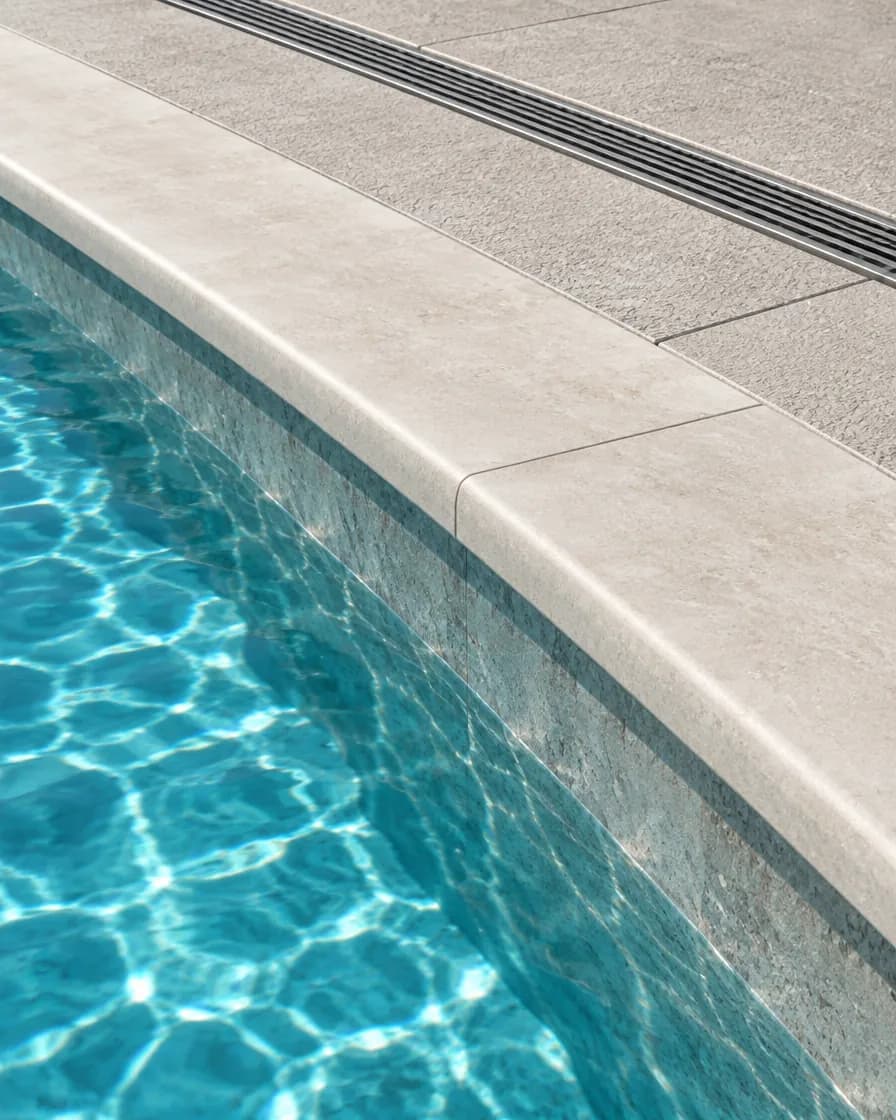
Beside a pool, the posts have to stay out of the deck. The Dubai Building Code asks for a continuous and unobstructed deck or walkway at least 1.2 m wide round a pool, so a pergola shading the water has to stand beyond that strip. The swimming pool construction page gives the fence and setback figures the pergola has to fit around.
On a roof, the pergola joins the roof terrace rules. An accessible roof needs a guardrail at least 1,200 mm high where the walking surface is 760 mm or more above finished floor level, and the 50% roof coverage question above applies.
Over a barbecue, the pergola becomes part of the cooking area's fire safety. Blaze's installation guide for its built-in gas grills names pergolas as partially enclosed areas, says the grill shall not be located under overhead construction, and sets a minimum of 6 feet, about 1.8 m, from countertop to any overhead structure where it is. Under combustible overhead construction, such as a timber pergola, it requires a vent hood larger than the cooking area. The outdoor kitchen page covers the rest of that job.
Do you need approval for a pergola in Dubai?
Usually, from the community first. Emaar Community Management's home modification guidance for Emirates Living, Arabian Ranches and Dubai Hills Estate names a garden pergola as work that needs a NOC, applied for through Home Modifications on the community portal. Emirates Living covers Emirates Hills, The Springs and The Meadows. In Emirates Living and Arabian Ranches, the same guidance says lights cannot be installed on top of, or on the community-facing side of, villa boundary walls, which matters for a pergola built against one.
On Palm Jumeirah and in Jumeirah Village Circle, Nakheel's rules turn on the contractor's access permit: modification work needs a valid Nakheel and Trakhees NOC behind it, while general and maintenance work needs an owner or tenant NOC instead. Whether the authority for the plot wants drawings as well depends on the structure and the plot, and the partner contractor confirms it before the order is placed. The renovation approvals guide sets out who applies for each approval.
- The community NOC, with a drawing showing the pergola's position against the boundary and the villa
- The contractor's access or entry permit for the community
- Any authority drawings the plot needs, confirmed by the partner rather than assumed
- A written answer on who applies for each one, before the contract is signed
Sources
- Home modifications, Emirates Living (Emaar Community Management)
- Home modifications, Arabian Ranches (Emaar Community Management)
- Home modifications, Dubai Hills Estate (Emaar Community Management)
- Emirates Living residences: Emirates Hills, The Springs, The Meadows (Emaar Community Management)
- Palm Jumeirah (Nakheel)
- Jumeirah Village Circle (Nakheel)
- Access permit FAQs, contact us (Nakheel)
How much does a pergola cost in Dubai?
Dubai Renovations does not publish pergola prices. The shopping results for this search price kits by the piece, and installers quote per square metre, and neither figure is what an installed pergola on your terrace costs, because the parts that move the number sit outside the kit.
Buying a kit and having one built are different purchases, the same split as buying a roll of artificial grass and having a lawn installed. A kit is the frame and roof delivered. An installed pergola adds the base it stands on, the fixings into the villa, the drainage, the power and the approvals. On a sound slab with no services, a kit can be the sensible answer. Where a motor, lighting or a fixing into the villa wall is involved, the installation is where the work is.
Size matters in steps rather than smoothly. A pergola sold as 20 x 20 feet is about 6.1 m square, roughly 37 m², which is just past the 6 x 6 m that the Renson sheet above gives for one roof section without an intermediate column. A few centimetres can add a post or a beam. These are the lines that move a pergola quote:
- Span and area, and whether the size needs an extra post or an intermediate beam
- Roof type: fixed slats, rotating louvres, retractable fabric or solid panels
- Frame material and finish, including a coastal-grade coating near the water
- Footings: fixing to an existing slab, or new pads in the garden
- Fixing to the villa wall, and making good the waterproofing where it is drilled
- Drainage routed down the columns and away from the house
- Power for a motor, lighting and sensors, with outdoor switches and sockets rated IP55 as Part K requires
- Side screens or glazing, which also raise the covered-space question
- The community NOC and the contractor's access permit
- VAT, charged in the UAE at a standard rate of 5% since 1 January 2018
Pergola work through a Dubai summer
Putting up a pergola is outdoor work, so the UAE midday break applies: no work under direct sunlight in open places between 12:30 pm and 3 pm from 15 June to 15 September. Footings and fixing go in the morning. A frame that is quick to erect in March takes longer in August, and the programme in the quote should say how it handles that.
What to ask at the pergola visit
The frame is the easy part to compare. These questions bring out the parts that differ between quotes while the partner is still standing on the terrace.
- What wind speed is this roof rated for, open and closed, and can I see the maker's test certificate?
- Who checked the posts, base plates and wall fixings against the Dubai Building Code's wind figures?
- What is the solar reflectance index of this finish, and does the pergola count as shade for the code's 50% hardscape rule?
- Where does the water go, and how many drainage points does the roof need?
- What does it stand on, and what happens to the terrace waterproofing where it is fixed?
- What power does the motor need, and are the outdoor switches and sockets IP55?
- If I close it in later, does that change the approvals?
- Who applies for the community NOC and the access permit?
Questions
How much does a pergola cost in Dubai?
Dubai Renovations does not publish a pergola price. An installed pergola is priced on its span, the roof type, the frame material and finish, what it stands on, how it fixes to the villa, the drainage, the power and the approvals, and those are settled at the visit. The partner contractor gives you a written quote and signs the contract with you.
Is it cheaper to buy a pergola or build one?
A kit costs less than an installation because it leaves things out: the base, the fixings into the villa, the drainage, any power and the approvals. On a sound slab with no services, a kit can be enough. Where a motor, lighting or a fixing into the villa wall is involved, the installation is where the work is.
How much does a 20x20 pergola cost?
Dubai Renovations does not publish prices. A 20 x 20 foot pergola is about 6.1 m square, roughly 37 m², which is just past the 6 x 6 m one louvred roof maker gives for a single section without an intermediate column, so the size can add a post or beam. The partner quotes on the measured span.
Does a pergola count towards my villa's built-up area?
No. The Dubai Building Code excludes lightweight outdoor shading structures such as pergolas and standalone canopies from built-up area (A.5.2.2), and excludes pergolas from plot coverage (K.5.2.7). A solid roof carried on the villa with walls or glazing added is a covered space, and a different job.
Can a pergola be built up to the boundary in Dubai?
The Dubai Building Code allows pergolas and lightweight parking shading structures within the setbacks up to the plot limit (K.5.2.4). Your community's rules still apply: in Emirates Living and Arabian Ranches, Emaar Community Management does not allow lights on top of, or on the community-facing side of, villa boundary walls.
Do I need a NOC for a pergola in Dubai?
Usually. Emaar Community Management names a garden pergola as work that needs a NOC in Emirates Living, Arabian Ranches and Dubai Hills Estate, applied for through Home Modifications. On Palm Jumeirah and in Jumeirah Village Circle, Nakheel's access permit rules apply. The partner contractor makes the applications.
Can I put a barbecue under a pergola?
Check the grill's own manual first. Blaze's guide for its built-in gas grills says they shall not be located under overhead construction, asks for at least 6 feet from countertop to any overhead structure where they are, and requires a vent hood under a combustible roof such as timber. The outdoor kitchen page covers the rest.
Send the job on WhatsApp
Choose what fits and WhatsApp opens with the message written. Add a photo of each room in the chat.