
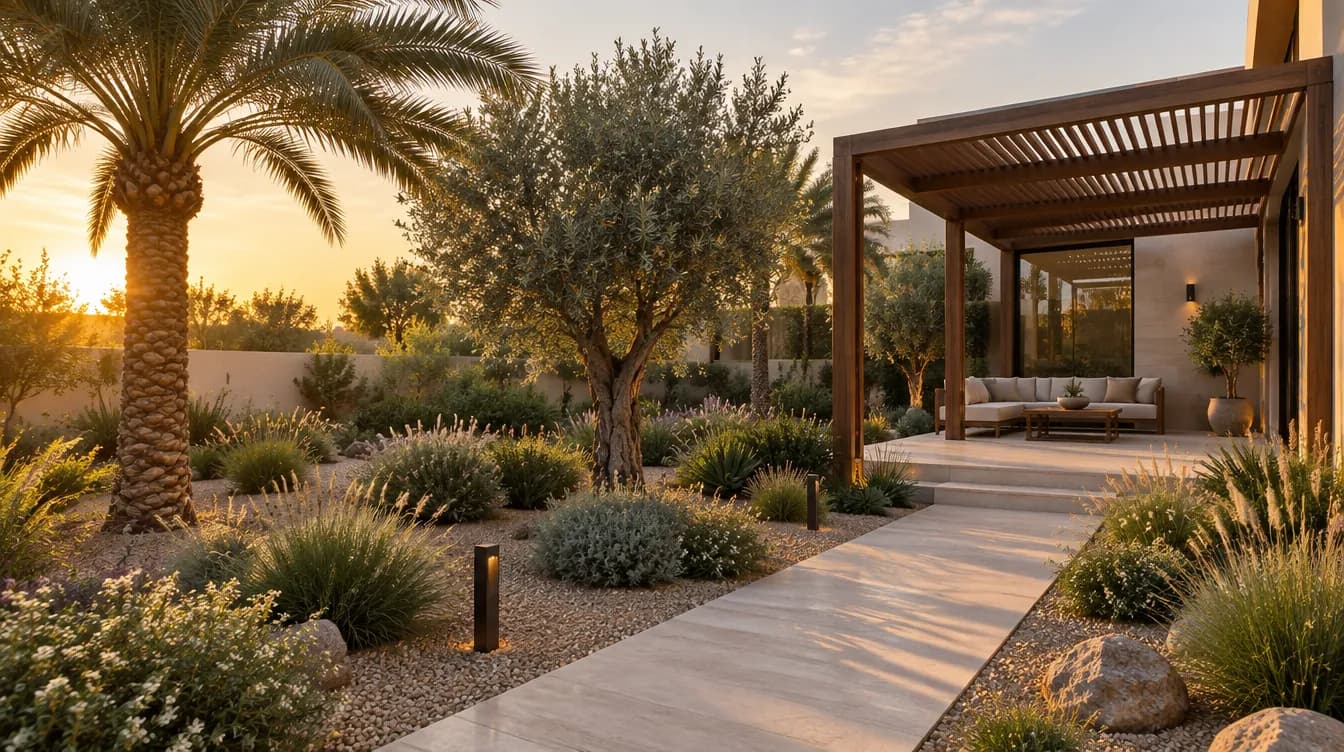
Landscaping in Dubai
Planting, paving, irrigation, shade and lighting. Describe the garden you want and a partner contractor visits, quotes and signs with you.
Landscaping in Dubai covers the ground outside the villa: planting, irrigation, paving and decking, shade structures, lighting and drainage. Dubai Renovations takes your enquiry and briefs a partner contractor, who visits, quotes, signs the contract with you and does the work. Two published rules shape almost every garden here before taste comes into it: a quarter of the planted area has to be indigenous or Dubai-adapted species, and exterior planting is watered from non-potable water or by drip and subsoil systems.
Gardens in Dubai fail for a small number of reasons, and almost all of them are decided before a plant goes in: the wrong species for an August, irrigation sized for a cooler place, dark paving nobody can walk on barefoot, and water with nowhere to go when the rain does arrive. This page covers what the code requires, what the partner needs to see, and what to ask while they are standing in the garden.
What a Dubai villa landscaping job is made of
A garden job is five trades that meet in one place, and the order they meet in is what separates a quote that holds from one that grows. Ducts and irrigation lines go in before paving, not after. Levels get set before anything is laid. Planting is last, because it is the part that suffers if it goes in early.
Tell Dubai Renovations which of these you want and how far you want to go, and the partner contractor sorts it into a scope at the visit. You do not need to know what it is called to describe it.
| Part of the garden | What it covers | What the partner needs to see |
|---|---|---|
| Softscape | Trees, palms, shrubs, ground cover, turf and topsoil | The aspect, the shade the plot already has, and how much watering you want to commit to |
| Hardscape | Paving, decking, steps, retaining walls, edging and the driveway | Levels across the plot, and where water runs after heavy rain |
| Irrigation | Drip lines, subsoil delivery, valves, a controller and backflow protection | The water source, the tank or connection point, and any existing controller |
| Shade | Pergolas, canopies, shade sails, and planting used as shade | Which parts of the garden you use, and at which hours |
| Lighting and power | Garden lighting, power for irrigation and pool plant, ducts under paving | The distribution board and whether it has spare ways |
| Drainage | Falls, channels, soakaways and where the water finally goes | Any standing water after rain, and the level of the villa's own thresholds |
A quarter of the planting has to be local
The Dubai Building Code sets a floor on local planting. At least 25% of the total planted area within the building plot, green roofs included, has to use indigenous plant and tree species, or species that can adapt to the environment of Dubai. Note what it is a quarter of: the planted area, not the plot. Paving and pool decks do not dilute the figure.
In practice the rule pushes a garden towards plants that survive a Dubai August without a heroic irrigation bill, which is the same direction the water rules push. Ask the partner to mark the indigenous and adapted share on the planting plan rather than leaving it to be counted afterwards, because moving a tree on a plan costs nothing and moving a planted one costs a tree.
What you are allowed to irrigate with
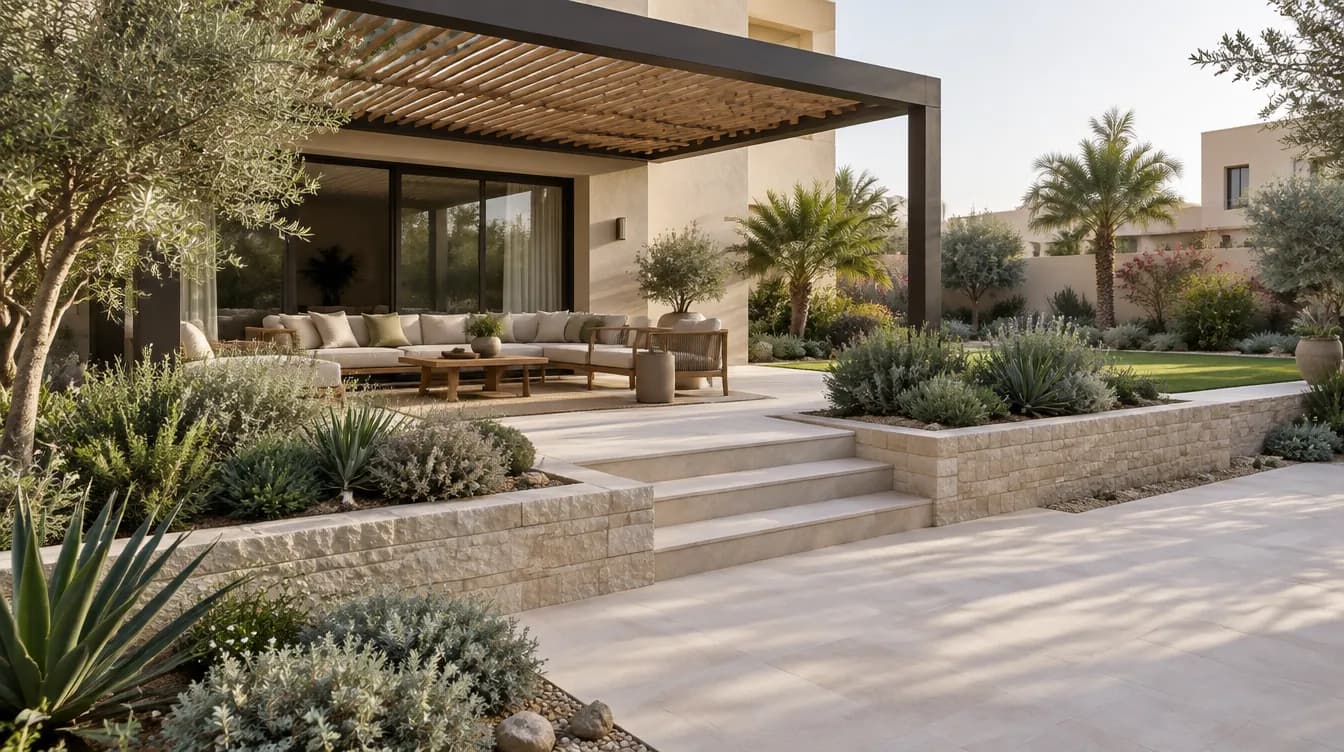
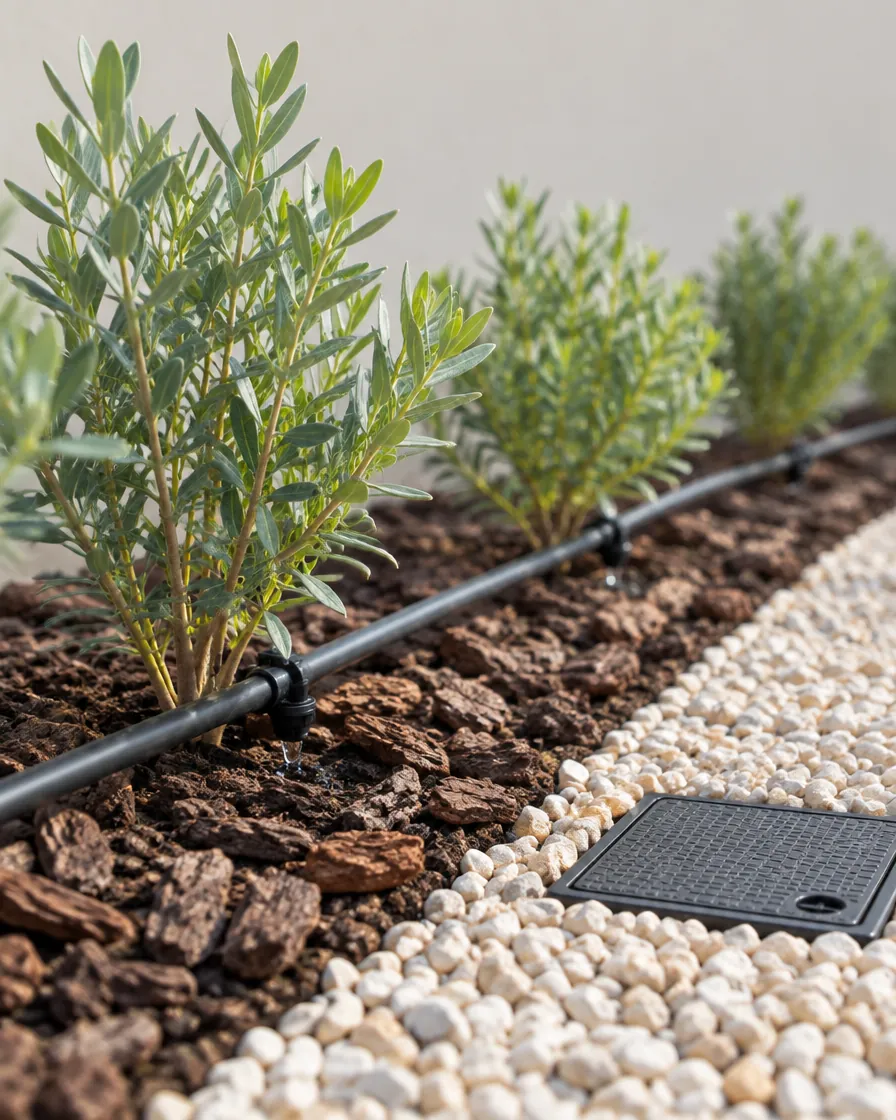
Exterior landscaping, green roofs included, is to be irrigated using non-potable water, or by drip or subsoil water delivery systems. Every irrigation system connected to a potable source anywhere has to carry backflow prevention devices, installed in line with the manufacturer's requirements. Those two sentences shape the whole irrigation design, and they are the reason a Dubai garden is rarely watered by a sprinkler on a hose.
Where a recycled supply is used, the code names greywater recycling and condensate reuse as suitable systems, fed from dedicated pipework with isolation and drain valves and clearly labelled components so nothing cross-connects with the drinking supply. Above-ground sprinklers that throw an aerosol of droplets need water disinfection; subsurface irrigation does not. In a city where air conditioning runs most of the year, condensate is a real source rather than a theoretical one.
Surface heat, shade and why paving colour is a decision
Dubai's code treats surface heat as a design problem rather than a comfort preference. At least 50% of a development's hardscape has to do one of five things: reach a solar reflectance index of at least 33, use an open grid pavement system, be shaded by vegetation, be shaded by materials meeting the code's index figures, or be shaded by solar panels.
Shading over walking routes carries its own numbers. Pedestrian links within the plot are to be shaded using materials with a solar reflectance index of at least 29 for steep sloped shading devices, steeper than 1 in 6, and at least 78 for flat and low sloped ones. A dark paving choice and a flat dark canopy are the two ways a garden fails this, and both get picked off a sample board in an air-conditioned room.
Approvals, and what a garden does not use up
A garden is an external change, so the community usually has a view. In Emirates Living and Arabian Ranches, Emaar Community Management requires any alteration to a villa to be approved by Emaar, and communities control contractor access, delivery hours and skip placement as well. The partner contractor applies, and you sign what has to come from the owner.
Which rulebook applies depends on the community. Emaar Community Management runs Home Modifications for Emirates Living, covering Emirates Hills, The Springs and The Meadows, and for Arabian Ranches and Dubai Hills Estate, where a garden pergola needs a NOC. On Palm Jumeirah and in Jumeirah Village Circle a contractor's access permit for modification work needs a valid Nakheel and Trakhees NOC, while general and maintenance work needs an owner or tenant NOC instead. Jumeirah Lake Towers owners go through DMCC. Give the community name in the enquiry, because it changes who applies and what they have to submit.
One thing works in a garden's favour. Non-covered outdoor landscape and hardscape surfaces are excluded from the total built-up area, and so are lightweight outdoor shading structures such as pergolas and standalone canopies. A terrace, a planted garden and a pergola over it do not eat the plot's built-up area the way a covered room does, which is worth knowing on a plot where an extension would not fit.
Sources
- Home modifications, Emirates Living (Emaar Community Management)
- Home modifications, Arabian Ranches (Emaar Community Management)
- Home modifications, Dubai Hills Estate (Emaar Community Management)
- Emirates Living residences: Emirates Hills, The Springs, The Meadows (Emaar Community Management)
- Palm Jumeirah (Nakheel)
- Jumeirah Village Circle (Nakheel)
- Support services, JLT property owners (DMCC)
- Dubai Building Code, 2021 edition (Dubai Development Authority)
Garden work through a Dubai summer
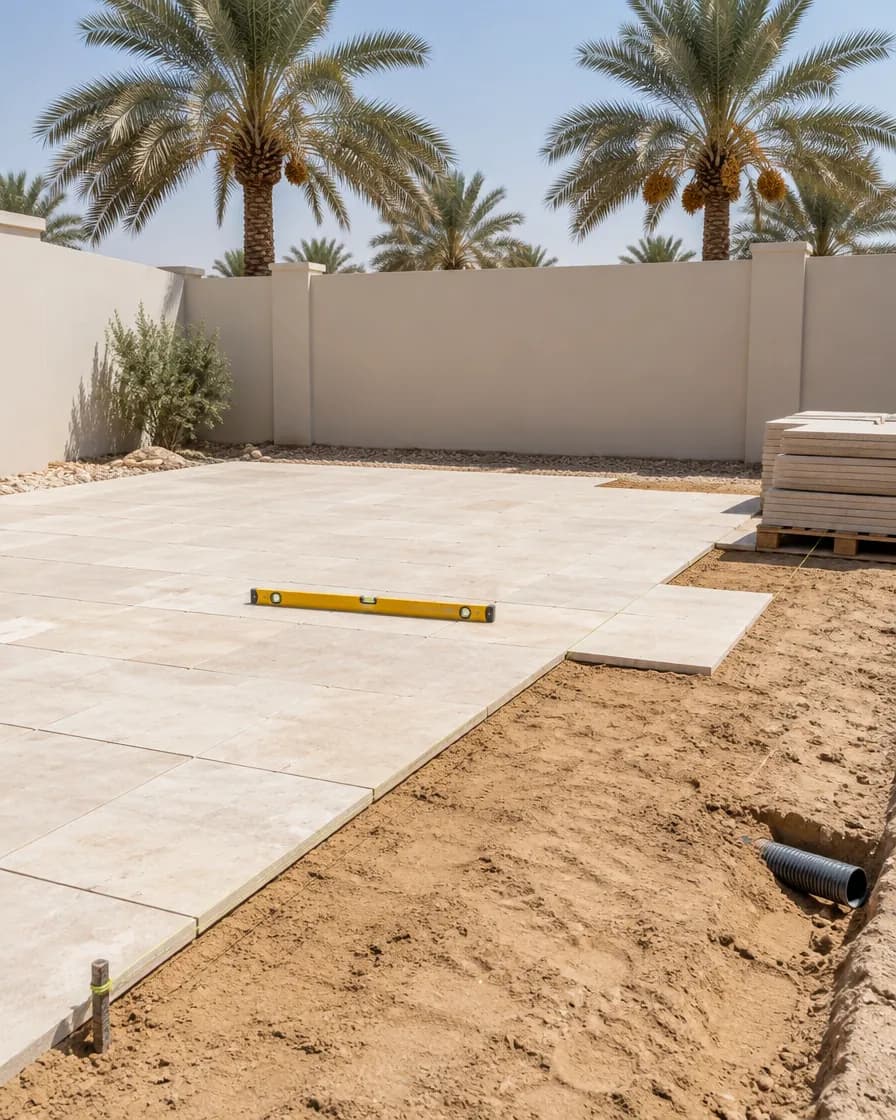
Landscaping is outdoor work end to end, so the UAE midday break sets the working day for the whole job rather than for one trade on it. Work under direct sunlight and in open places is not allowed between 12:30 pm and 3 pm from 15 June to 15 September. Paving, planting, excavation and pergola erection all sit squarely inside that.
It changes the programme rather than stopping it: a partner working through those months starts early, breaks, and comes back in the late afternoon. Ask how the dates in the quote account for it, and ask what the plan is for keeping new planting alive between going in and the irrigation being commissioned.
What to ask at the landscaping visit
Garden quotes vary more than any other trade on this site, because two of them can describe completely different builds under the same surface. These questions separate them while the partner is still on the plot.
- Where does water go after heavy rain, and what in this quote changes that?
- What share of the planting is indigenous or Dubai-adapted, and which plants are they?
- Is the irrigation drip, subsoil or sprinkler, and what is the water source?
- Is backflow protection included at the connection point?
- What is the paving's finish and colour, and how hot does it get barefoot in July?
- Are ducts for lighting and future power laid before the paving goes down?
- Who maintains the garden after handover, and for how long is that in the price?
Questions
Do I need permission to landscape my villa garden in Dubai?
Usually yes. A garden is an external change, and communities such as Emirates Living and Arabian Ranches require any alteration to a villa to be approved by Emaar Community Management. Communities also control contractor access and delivery hours. The partner contractor makes the applications.
How much of a Dubai garden has to be local planting?
At least 25% of the total planted area within the building plot, green roofs included, has to be indigenous plant and tree species or species that can adapt to the environment of Dubai, under the Dubai Building Code.
What can I use to irrigate a garden in Dubai?
The Dubai Building Code says exterior landscaping is to be irrigated using non-potable water, or by drip or subsoil delivery. Greywater recycling and condensate reuse are named as suitable recycled sources, and any system connected to a potable supply needs backflow prevention.
Does a new terrace or pergola count towards my built-up area?
No. Non-covered outdoor landscape and hardscape surfaces are excluded from the total built-up area, and so are lightweight outdoor shading structures such as pergolas and standalone canopies. A covered, enclosed garden room is a different matter.
What does landscaping cost in Dubai?
Dubai Renovations does not publish a garden price. Landscaping is priced on the area, the levels, how much hardscape and drainage the plot needs, the planting and the irrigation, and those are settled at the visit. The partner contractor quotes in writing and signs the contract with you.