
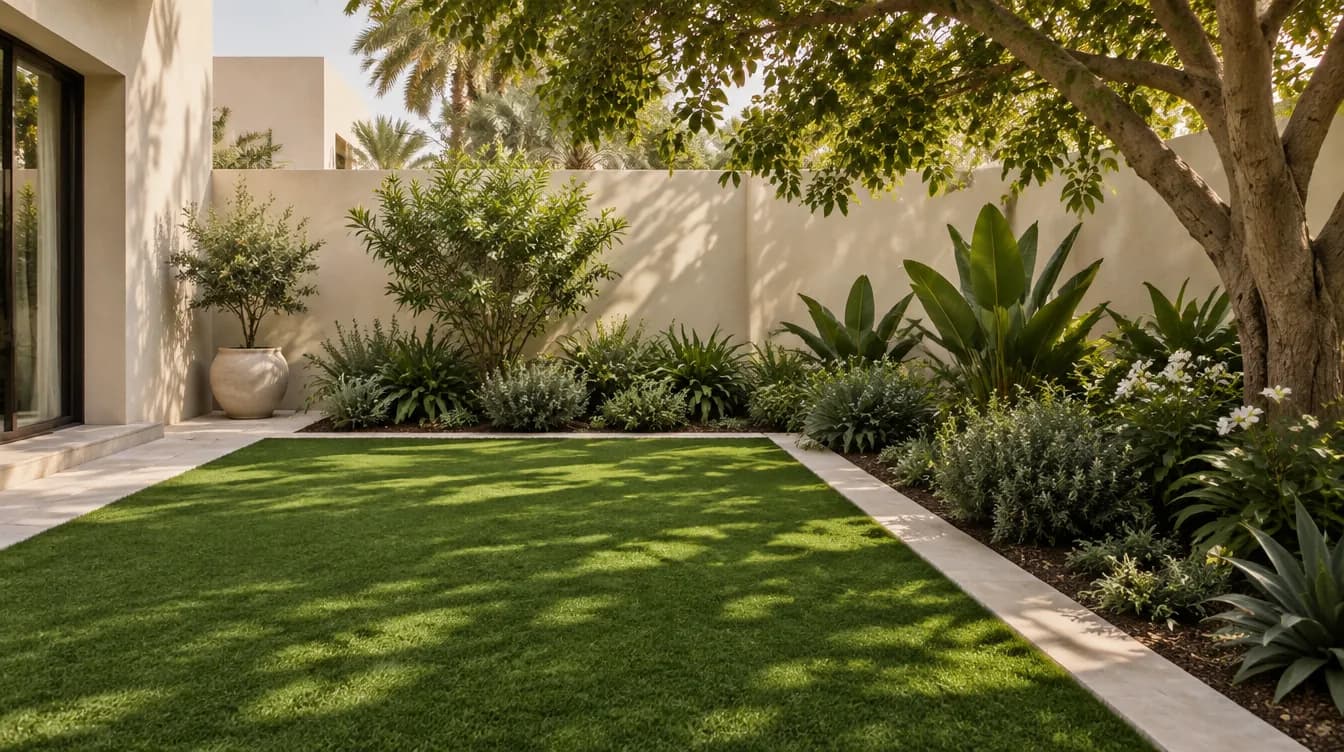
Artificial grass installation in Dubai
The base under it matters more than the roll on top. A partner contractor visits, quotes and lays it, and signs the contract with you.
Artificial grass installation in Dubai is a groundworks job with a surface on top. The roll is the cheap part. The base under it, the falls that carry water away and the edge that holds it down decide how long it lasts. Dubai Renovations takes your enquiry and briefs a partner contractor, who visits, quotes, signs the contract with you and lays it. What the area is for comes first at the visit: a play lawn, a pool surround and a roof terrace need different builds.
Most of what is sold as artificial grass in Dubai is sold by the square metre, as a roll, from a shop or an online marketplace. That is a supply price, and it is not the same job as an installed lawn with a compacted base, drainage and seamed joints. This page is about the installed version: what heat does to it, where it helps a garden, and where it makes one unusable.
Supply and installation are two different purchases
The confusing part of shopping for artificial grass in Dubai is that the same words cover two very different things. One is a roll delivered to the villa. The other is a finished lawn that drains, sits flat, and has no visible joins. The price gap between them is not margin; it is the ground under the grass.
Neither is wrong. If a balcony needs covering, a roll and a knife is a sensible answer. If a garden is being rebuilt, the roll is the last five per cent of the work, and buying it first tends to fix the wrong decision in place.
| What is quoted | What you get | Where it makes sense |
|---|---|---|
| Grass by the square metre | A roll, cut to a width, delivered | A balcony, a terrace already laid flat, a temporary cover |
| Supply and lay | The roll, cut in and fixed to the existing surface | A sound, level, draining surface that is staying |
| Full installation | Excavation, a compacted base to falls, membrane, edge restraint, seamed joints and infill | A garden, a play area, a pool surround, anything on soil |
How hot artificial grass gets
Synthetic turf gets far hotter than the grass it replaces, and the measurements are not close. Researchers at the University of Nevada, Las Vegas and the Desert Research Institute recorded maximum surface temperatures on green artificial turf of 169 °F, about 76 °C, which was 69 °F above irrigated natural grass beside it and 62 °F above the air temperature. They put that 46 °F above a threshold earlier research had set for safe extended use, 123 °F or roughly 51 °C.
Penn State's Sports Surface Research Center puts the ceiling higher. The highest figure it cites from published research is 200 °F, 93 °C, on a 98 °F, 37 °C day, and on its own central Pennsylvania trials it measured 175 °F, 79 °C. Las Vegas and Pennsylvania are not Dubai. But a 37 °C afternoon is an ordinary Dubai summer day for months at a time, and Las Vegas is a desert city, so the direction of these numbers transfers even if the exact readings do not.
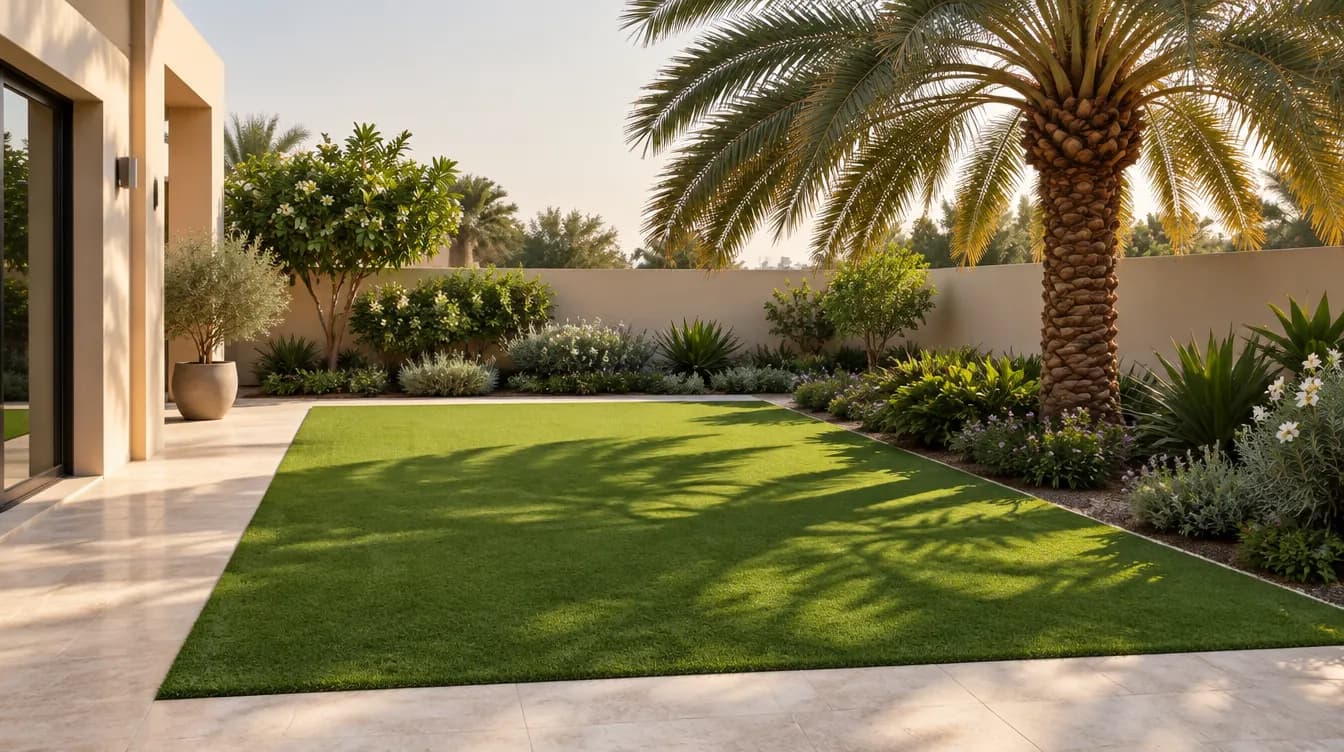
Watering it works, and it stops working quickly
Hosing artificial grass down does cool it, and the cooling is shorter than most people expect. Penn State measured a synthetic surface at 174 °F, 79 °C, watered it for half an hour, and saw it fall to 85 °F, 29 °C. Five minutes after the water stopped it read 120 °F, 49 °C. Twenty minutes after, it was back to 164 °F, 73 °C.
That is the fact to have before a lawn is specified for children or a dog. Watering is a short intervention, not a fix, and an artificial lawn in full sun is not a usable surface in the middle of a Dubai summer day whatever is done to it. Shade changes the answer completely, which is why the useful question at the visit is how many hours of direct sun the area actually gets.
Where it earns its place, and where it does not
The Dubai Building Code gives two reasons to think about where the grass goes rather than how much of it there is. At least 50% of a development's hardscape has to reach a solar reflectance index of at least 33, use an open grid pavement system, or be shaded by vegetation, by materials meeting the code's index figures, or by solar panels. And at least 25% of the total planted area within the plot has to be indigenous or Dubai-adapted species.
Laying synthetic turf over a lawn shrinks the planted area that second figure is measured against, and it brings no shade of its own. A garden that keeps its trees and its planted beds and uses artificial grass for the shaded strip where nothing ever grew is a sensible use of the material. A plot turfed corner to corner is the version that produces a hot, bright, unusable garden and a surprised owner in July.
What the build under the grass has to do
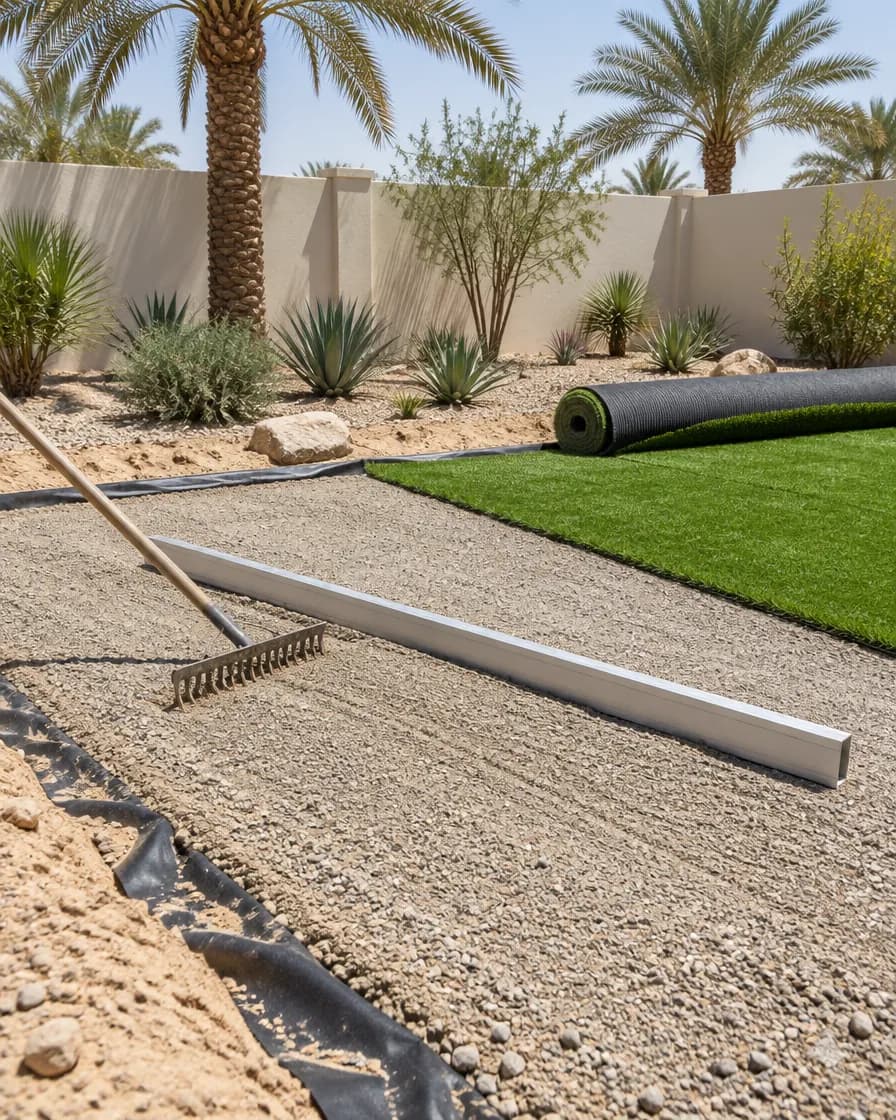
Most artificial lawns that look wrong after a couple of summers failed below the surface rather than at the pile. Water stands because nobody set the falls. Edges lift where nothing restrains them, and joins open and start to show once the base underneath has moved.
A partner contractor quoting a full installation is quoting the groundworks. Ask them to describe the build-up rather than the product, because that is the part you cannot inspect once the grass is down.
- Strip the existing surface and take out roots and spoil, rather than laying over dead turf
- A compacted sub-base and a laying course, set to falls so water leaves the area instead of standing under the grass
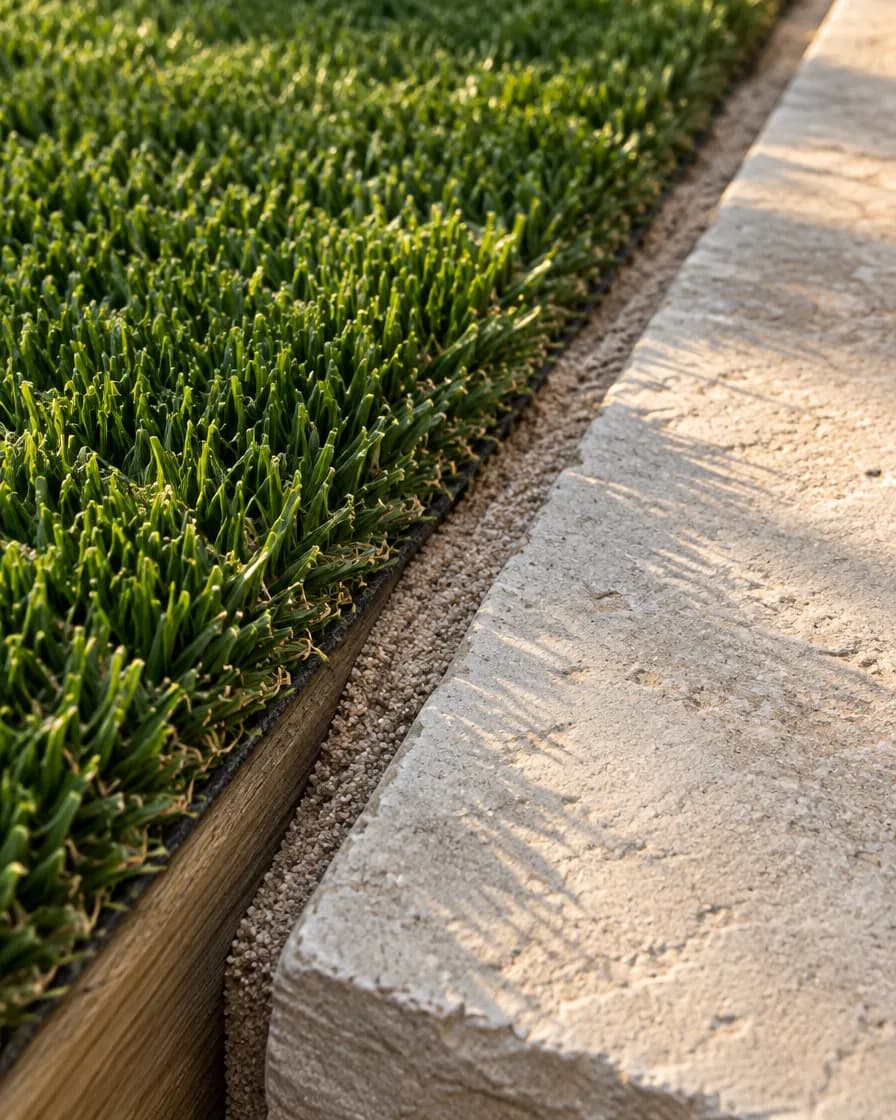
- A weed membrane below the base, and edge restraint at every boundary so the edges cannot lift
- Joints seamed and fixed, with the pile running the same way across every roll
- Infill brushed in to hold the pile upright, with the type chosen for how the area is used
- Around a pool, a build that drains freely, and written confirmation the specification suits splash-out and pool water
- Around planting, an edge detail that separates irrigated beds from the base so the base is not being watered
Approvals and summer working
Artificial grass changes the external appearance of a villa plot, so the community usually has a view on it. In Emirates Living and Arabian Ranches, Emaar Community Management requires any alteration to a villa to be approved by Emaar. Front gardens visible from the street attract more attention than a rear garden behind a wall, and it is cheaper to ask before the excavator arrives.
The community matters more here than the material does, because turf changes what a plot looks like from the street. Emaar Community Management runs Home Modifications for Emirates Living, which covers Emirates Hills, The Springs and The Meadows, and for Arabian Ranches and Dubai Hills Estate. Emirates Hills goes further than most: its published guidance says external modifications that change the look of the villas are not permitted. On Palm Jumeirah and in Jumeirah Village Circle, Nakheel's access permit rules apply, and in Jumeirah Lake Towers it is DMCC. Ask before the grass is ordered, not after it is cut.
The groundworks are outdoor work, so the UAE midday break applies here too: no work under direct sunlight in open places between 12:30 pm and 3 pm from 15 June to 15 September. Excavation and base compaction are the parts that lose hours to it, and laying the grass itself is quick by comparison.
Sources
- Home modifications, Emirates Living (Emaar Community Management)
- Home modifications, Arabian Ranches (Emaar Community Management)
- Emirates Living residences: Emirates Hills, The Springs, The Meadows (Emaar Community Management)
- Home modifications, Dubai Hills Estate (Emaar Community Management)
- Palm Jumeirah (Nakheel)
- Jumeirah Village Circle (Nakheel)
- Support services, JLT property owners (DMCC)
- Health and safety at the workplace, mid-day break (UAE Government portal)
What to ask at the visit
The questions worth asking are about the ground and the sun, not about the grass. Two quotes naming the same product can describe entirely different jobs.
- How many hours of direct sun does this area get in July, and is that why we are choosing grass for it?
- What is the full build-up under the grass, layer by layer?
- What falls are being set, and where does the water go?
- How are the edges restrained, and what happens where the grass meets paving and planting?
- How many joins will there be, where do they fall, and how are they seamed?
- What infill is being used, and is it suitable for children or a dog?
- What does maintenance look like, and who does it?
Questions
How hot does artificial grass get?
Researchers at the University of Nevada, Las Vegas and the Desert Research Institute recorded green artificial turf at a maximum of 169 °F, about 76 °C, which was 69 °F hotter than irrigated natural grass beside it and 62 °F above the air temperature. Penn State cites a published high of 200 °F, 93 °C, on a 98 °F day.
Does watering artificial grass cool it down?
Briefly. Penn State watered a surface reading 174 °F, 79 °C, for half an hour and measured 85 °F, 29 °C. Five minutes later it was 120 °F, 49 °C, and twenty minutes later 164 °F, 73 °C. Watering is a short intervention rather than a fix.
Is artificial grass a good idea in a Dubai garden?
In the right place. It suits a shaded strip where nothing grows, and it suits an area that cannot be irrigated. It does not suit a plot turfed corner to corner in full sun, because it brings no shade, it gets far hotter than planting, and it reduces the planted area the code's local-species rule is measured against.
What is the difference between buying artificial grass and having it installed?
A square-metre price buys a roll. An installation buys the groundworks under it: excavation, a compacted base set to falls, a weed membrane, edge restraint, seamed joints and infill. On soil, the base is what decides whether the lawn still sits flat and drains in a few years.
Do I need approval to lay artificial grass?
Usually, because it changes the external appearance of the plot. Emaar Community Management requires any alteration to a villa in Emirates Living or Arabian Ranches to be approved by Emaar, and other communities have their own rules. The partner contractor makes the application.